
Mercari (メルカリ) is one of Japan’s largest peer-to-peer marketplaces. Out-of-print cards, limited-run merchandise, discontinued toys, vintage clothing — for collectors it is close to shorthand for “the Japanese treasure chest”, and the prices are often genuinely good.
But it is a C2C marketplace: seller quality varies enormously, and the information that matters is usually buried in a long Japanese description rather than stated in the title. Reading listings and reading sellers is what actually separates a good buy from an expensive lesson. These five checks cover the traps overseas buyers hit most often.
The short version
- Read the whole description, never just the title. 観賞用, レプリカ and コピー品 all mean it is not authentic; 訳あり, 裸品 and ランダム mean damaged, unboxed or a random variant.
- Vet the seller before the item. A new account, almost no transaction history, and one or two expensive listings is the classic pattern.
- Verify the cert number on any graded card. Copied cert numbers and counterfeit labels genuinely exist, and checking takes under a minute.
What this guide covers
Three things to understand about Mercari first
The advice below makes more sense once these three are clear.
- 1Almost everything is one-of-one
These are individual sellers listing second-hand items, so a listing has exactly one buyer and disappears when it sells. Unlike a normal shop there is no restock — hesitate too long on something you want and it is simply gone.
- 2The platform does not vouch for authenticity
A C2C marketplace provides the venue, not the verification. Nobody checks each listing for authenticity or condition; that is entirely down to the seller. Which is exactly why you need a working eye of your own.
- 3It rarely ships overseas directly
This is the practical barrier for buyers outside Japan, and why most people use a proxy or forwarding service. With Collect2Day you can search Mercari listings in the same app, check out alongside fixed-price items from other marketplaces, and have it delivered to your own address.
Translate the whole description — the detail is not in the title
This is the easiest trap to fall into and the easiest to avoid. Japanese sellers routinely put the decisive information deep in a long description rather than in the title — “box only”, “random variant”, “one unit only”. A buyer who does not read Japanese can easily believe they are buying a complete set.
See any of these and walk away
| Japanese | What it means |
|---|---|
| 観賞用 (kanshōyō) | “For display” — not authentic |
| レプリカ/複製品 (replica / fukuseihin) | Reproduction — not authentic |
| コピー品 (kopī-hin) | Counterfeit — not authentic |
| 自作/ハンドメイド (jisaku / handmade) | Self-made or handmade — not official merchandise |
See any of these and check again before ordering
| Japanese | What to watch for |
|---|---|
| 外箱は当方にて用意/自作外箱 | The outer box is supplied by the seller — not the original packaging |
| 裸品 (hadaka-hin) | Loose item, no packaging or accessories |
| 簡易包装 (kan’i hōsō) | Minimal packaging — weaker protection in transit |
| 訳あり (wake ari) | Has a defect — find out exactly what |
| ランダム (random) | Random variant — you cannot choose |
What to do
- Get in the habit of translating the description in full, paying particular attention to quantity, what is actually being shipped, and return terms.
- For headline claims like “1BOX”, “原箱” (original box) or “未開封 BOX” (sealed box), check the body text confirms the packaging is the manufacturer’s.
- If a seller has written “proxy buyers welcome” or similar in English or Chinese, treat that as a reason for more caution, not less — those listings are often built specifically for overseas buyers.
Booster packs, lucky bags, gacha and limited sets can all be described as new by anyone holding the box, and you cannot check the contents in advance. For anything expensive and sealed, insist on photographs where the serial number, the anti-counterfeit sticker or the factory shrink-wrap is clearly visible.
Read the seller before you read the item
On a peer-to-peer marketplace the seller’s credibility is usually worth more of your attention than the item listing itself.
The classic warning signs
- A newly registered account, almost no transaction history, a handful of reviews.
- One or two expensive listings and nothing else.
- Plenty of reviews, but all of them generic, with no detail about the actual transaction.
Collect2Day has already filtered some of this out
When you browse Mercari listings inside Collect2Day, seller ratings are handled in two tiers — and the two do very different things:
Yahoo Auctions (JDirectItems) does not expose seller scoring through its search interface, so the warning badge can only appear on the product page — never in the list view. When browsing Yahoo listings you have to open the seller page yourself.
What to do
- Open the seller’s page and look at the shape of the business — steady listings over time, a consistent category, and reviews with actual detail all point the right way.
- No badge does not mean verified. It only means the seller is not below the warning threshold.
No real photographs, no order
Photographs are the most direct evidence of condition, and two kinds should worry you.
Two kinds of photograph to be wary of
- 1Nothing but official product shots
Immaculate, perfectly lit, and with no everyday angle, no in-hand shot and no unboxing. Often it means the seller does not have the item — they are reselling or acting as a middleman for something they have not seen either.
- 2Deliberately blurred, out of focus or badly lit
These can be hiding damage, staining, or the details that would give away a fake. Sharp photographs are not hard to take; a seller willing to do the job properly does not post only these.
What to do
Favour listings that have all three — real photographs, several angles, natural light — and make sure the following are legible:
| Item type | What must be clearly visible |
|---|---|
| Cards | Card number, set code, all four corners, the borders, and how the surface catches light |
| Boxed items | Factory seal, barcode, serial number, and all six faces of the box |
| Clothing and accessories | Brand labels, stitching, and the location of any defect |
A conspicuously low price is rarely good luck
“A PSA card at this grade should be thousands — why is this one a few hundred?” When a price sits well outside the accepted range, it usually is not a bargain.
A low price and a near-empty description is a red flag.
A price slightly under market is perfectly normal — a seller clearing space, an older item. But when it arrives together with a blank description, missing specifications and partial information, those listings tend to be damaged cards, opened product, defective items, empty boxes, or outright counterfeits.
What to do
- Before ordering, search completed sales for the same item over the past month and build yourself a reference price.
- If a price is more than about half below the going rate, step back and think.
- Ask questions when a description is thin. A seller who will not answer, or answers vaguely, has told you something useful.
Japanese domestic sale prices and international reference prices are not the same number, and without knowing that gap it is hard to tell a bargain from a warning sign. This piece has the actual figures: the gap between Japanese and international prices.
Verify any expensive graded card yourself
If you are buying a PSA or similar graded card, this step is not optional. Every PSA-graded card carries a unique cert number, and that number is registered in PSA’s own database along with the card’s images, grade and year. Sellers copying a genuine cert number onto a counterfeit label and slab is a real, documented practice.
- 1Zoom in until the cert number is sharp
Enlarge the listing photograph until every digit on the label is unambiguous.
- 2Look it up on PSA’s official site
The public database returns the registered record for that number.
- 3Compare every field
Card name, year, grade and images — all of them, against the card in front of you.
If anything fails to match, or the seller has conveniently obscured the number, walk away. The same method works for BGS, CGC and SGC.
For what actually separates the grades and why the prices diverge, see what separates a PSA 9 from a PSA 10. If you are buying Chinese-language cards, there is a separate guide to spotting error cards and print anomalies: how to identify Chinese-foil error cards.
How overseas buyers actually order
With the checks covered, here is the practical part. Since Mercari rarely ships abroad directly, Collect2Day handles the whole path:
- 1Browse and choose
Search Mercari, Yahoo Auctions Japan (JDirectItems) and eBay US listings in one app.
- 2One cart, one checkout
Put fixed-price items from different sellers and different marketplaces into the same cart and check out once; shipping and service fees are itemised at checkout.
- 3Pay in your own currency
The order settles in your region’s currency and you pay by card — no Japanese payment method and no Japanese address required.
- 4Delivered to your door
The seller ships to the Japan warehouse; once at the Hong Kong warehouse your items are consolidated automatically, and you can track the whole thing in the app.
Settling in your own currency means you do not absorb an exchange-rate spread — that part is a real saving. But it is a separate thing from your card issuer’s overseas transaction fee, which is charged based on where the merchant is located rather than which currency you were billed in, and so may still appear on your statement. Check your own issuer’s terms. What genuinely reduces is the number of such transactions: several sellers across several marketplaces become one payment instead of many.
All of the above describes fixed-price items. Auction listings cannot go in a cart — each one becomes its own bid order, and the payment sequence is different too. Full detail in the Yahoo Auctions bidding guide.
Item limits, what makes up the total, delivery timings and the consolidation rules are all covered separately in the multi-platform cart guide.
Common questions
Can Mercari ship directly to me?
Mercari serves the Japanese domestic market and generally does not ship overseas, which is why most overseas buyers use a proxy or forwarding service. With Collect2Day you can search Mercari listings in the app, order directly, and have the item delivered to your own address.
Are items on Mercari genuine? Does the platform check?
Mercari is a C2C marketplace and does not check each listing for authenticity or condition — that rests entirely with the seller. Read the description and the photographs, look at the seller’s history, and verify the cert number yourself on any expensive graded card.
Which Japanese words mean an item is not authentic?
観賞用 (for display), レプリカ and 複製品 (replica), コピー品 (counterfeit), and 自作 or ハンドメイド (self-made or handmade) all indicate a display piece, reproduction or home-made version rather than official merchandise. Walk away.
Is a listing marked “sealed” safer?
Not necessarily. Booster packs, lucky bags, gacha and limited sets can be called new by anyone holding the box, and the contents cannot be checked in advance — which makes them the hardest category to verify. For anything expensive, require photographs showing the serial number, anti-counterfeit sticker or factory shrink-wrap.
How do I tell whether a Mercari seller is trustworthy?
Look at the seller’s page as a whole: whether the trading history is long and steady, whether the categories are consistent, and whether reviews contain real detail. New accounts, near-empty histories, one or two expensive listings, or lots of generic reviews all warrant extra care.
Are the sellers shown in Collect2Day pre-screened?
Partly. Sellers below the minimum rating have their listings blocked entirely, so you never see them; sellers in the warning band appear normally but carry a warning badge. So the absence of a badge only means the seller is not below the warning threshold — it is not a verification, and the rest of the checks in this guide are still yours to do.
How do I verify a PSA card is genuine?
Enlarge the listing photograph until the cert number on the label is clearly readable, look that number up on PSA’s official site, and compare the card name, year, grade and images against the card being sold. If anything fails to match, or the number has been obscured, walk away. The same approach works for BGS, CGC and SGC.
If I pay in my own currency, does that mean no extra fees at all?
Paying in your own currency avoids the exchange-rate spread, but your card issuer’s overseas transaction fee is a separate charge — it depends on where the merchant is based, not on the currency you were billed in, so it may still appear. Check your issuer’s terms.
Can I check out Mercari items together with other marketplaces?
Fixed-price items, yes — items from different sellers and different marketplaces go into one cart and check out once. Auction listings cannot: each becomes its own separate bid order.
Next: place your first Mercari order with confidence
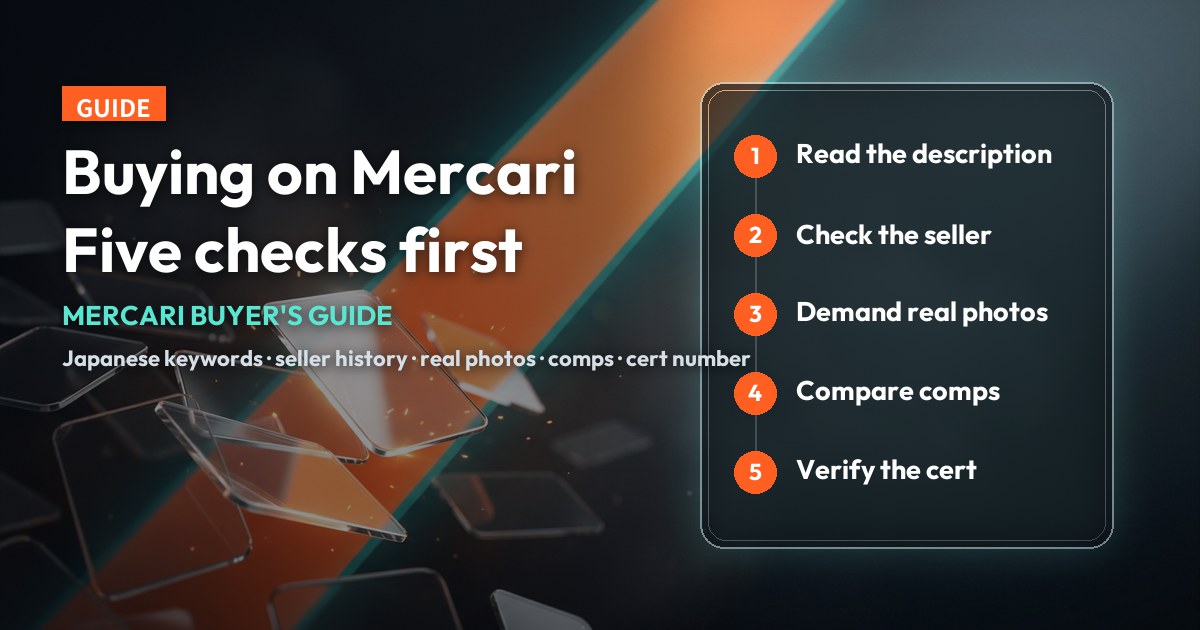
The treasure is genuinely there. What keeps people buying happily over the long run, though, is a steady set of habits — and these five avoid the overwhelming majority of the common traps.
Especially quantity, what ships, and return terms.
Account age, history and review detail say more than the photos.
No multi-angle natural-light shots means no information.
Use the last month’s actual results, not your impression.
Cert numbers on graded cards take under a minute to check.
No account yet? Start with sign-up and your delivery address: the Collect2Day sign-up guide
Ready? Search Mercari on Collect2Day, order in your own currency, delivered to your door.
Search Mercari listings