
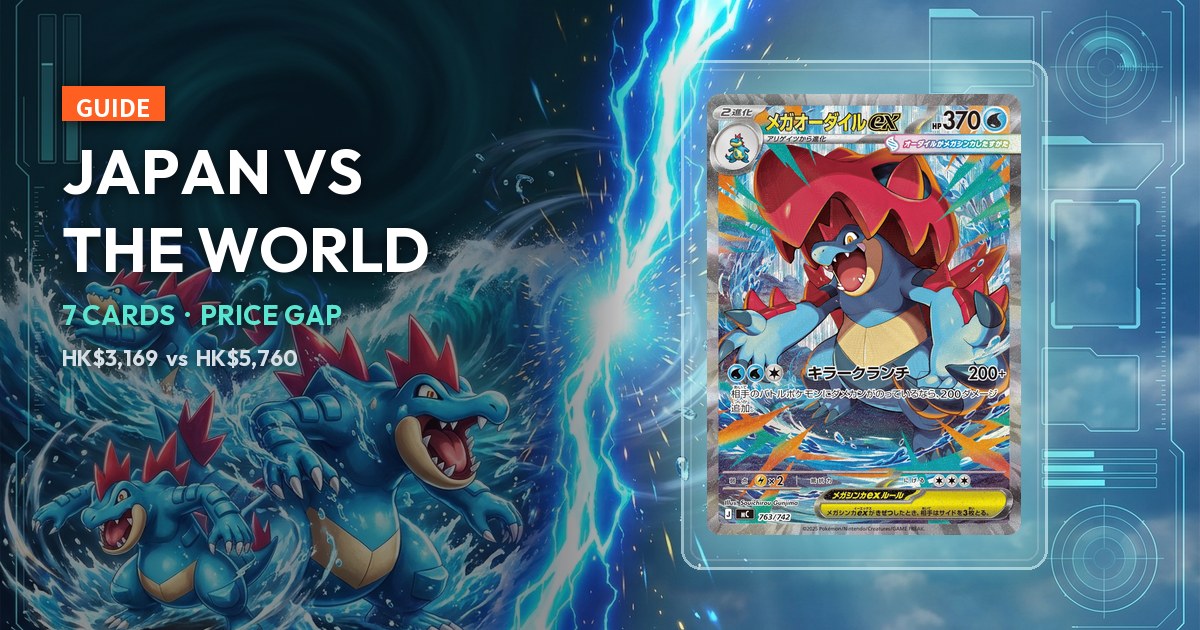
One card: a median Japanese sale price of HK$983, an international collector-market reference of HK$2,056 — a gap of HK$1,073. It looks like the amount you save by buying from Japan. It isn’t. The two figures are not the same kind of price: one is what people paid, the other is what sellers are asking. And freight and proxy fees are not in either of them. Seven cards below, showing how to read the gap and when it shrinks to nothing.
The short version
- The two numbers are different kinds of price. Japan is a median of completed sales; the international reference is a snapshot of listing prices, blended across several variants. An ask always sits above a trade.
- The gap is not the saving. Landed cost = Japanese price + international freight + proxy service fee, and neither fee shrinks with the card. The 5th card’s entire gap is HK$159.
- Check the sale count first. Five of these seven had only 3–4 Japanese sales in seven days, so the median is indicative at best.
Why the gap is not the saving
The most common mistake in cross-market comparison is subtracting two numbers that came from different places. The Japanese figure here is the median of sales that actually completed in the last seven days. The international reference is a snapshot of listing prices from the global collector market, medianed across several variants of the same card — usually eight. A listing is what a seller is asking, not what a buyer paid, so it sits systematically above transacted prices. Subtract one from the other and the gap you get is wider than the real one.
The second point is more practical: the gap is not a saving on landed cost. Buying from Japan adds international freight and a proxy service fee on top of the card price, and neither shrinks as the card gets cheaper. The 5th card below has a gap of HK$159; the 1st has HK$1,073. The same fixed fee means something completely different to each. On low-priced cards the gap only survives if you spread shipping across several cards in one order.
The third is sample size. Five of the seven had 3–4 Japanese sales in seven days; only the 4th had 18. The fewer the sales, the more one transaction can move the median. Each card below shows its Japanese sale count alongside how many variants the international reference blends, so you can see how solid each half of the comparison is.
All seven together: HK$3,169 in Japan against HK$5,760 internationally, a gap of HK$2,591 or about 45% — before any freight or proxy fee.
Seven cards, largest gap first
-
#1
MC 763/742 メガオーダイルex SAR仕様
Mega Feraligatr ex, SAR spec
MC 763/742 · SAR spec, above the base numbering
Start Deck 100 “Battle Collection” (スタートデッキ100「バトルコレクション」)
3 Japanese sales (7 days) · reference blends 8 variants
Japanese median sale price (ungraded)
HK$983
Find this card on Collect2Day ›What this card demonstrates
The widest gap of the seven at HK$1,073, 52% below the international reference. It comes from Start Deck 100 “Battle Collection” — a ready-built deck rather than a booster product — and the SAR spec sits above the 742 base numbering, so circulation is thin by design and international supply is expensive to assemble. Two limits though: only 3 Japanese sales in seven days, so the median is thinly supported, and the HK$2,056 is a listing reference blended from 8 variants, not any completed sale. Biggest gap, not the most reliable number.
-
#2
MC 761/742 メガメガニウムex SAR仕様
Mega Meganium ex, SAR spec
MC 761/742 · SAR spec, above the base numbering
Start Deck 100 “Battle Collection” (スタートデッキ100「バトルコレクション」)
3 Japanese sales (7 days) · reference blends 8 variants
Japanese median sale price (ungraded)
HK$845
Find this card on Collect2Day ›What this card demonstrates
Same box as the 1st card, one rung cheaper: HK$845 in Japan against HK$1,479, a gap of HK$634 or 43%. This is the classic sister-card discount — same set, same SAR spec, equally above the base numbering, differing only in character popularity, and both prices step down together. Same data limits as the 1st: 3 Japanese sales, 8 blended variants. If you want both, one order sharing one shipment is the way this pair’s gap actually survives.
-
#3
SV8a 212/187・2024 ニンフィアex SAR
Sylveon ex SAR
SV8a 212/187 · Special Art Rare (SAR)
High class pack “Terastal Festival ex” (テラスタルフェスex)
4 Japanese sales (7 days) · reference blends 8 variants
Japanese median sale price (ungraded)
HK$795
Find this card on Collect2Day ›What this card demonstrates
A gap of HK$343, 30% — the narrowest margin here. A narrow margin is information in itself: the two markets value this card similarly, so there is little cross-market room. It comes from “Terastal Festival ex”, a set built around the Eevee family, and the SAR’s full-body composition has a steady following on both sides. 4 Japanese sales, 8 blended variants.
-
#4
MC 085/742 メガリザードンYex ミラー
Mega Charizard Y ex, mirror
MC 085/742 · Mirror finish, within the base numbering
Start Deck 100 “Battle Collection” (スタートデッキ100「バトルコレクション」)
18 Japanese sales (7 days) · reference blends 24 variants
Japanese median sale price (ungraded)
HK$154
Find this card on Collect2Day ›What this card demonstrates
The best-evidenced card here: 18 Japanese sales in seven days against 3–7 for every other. Volume means stock is actually there when you want it, which is worth something on its own. The HK$160 gap at 51% is modest in cash terms, but this is a mirror finish inside the base numbering — high supply, low entry — a different route entirely from the extended slots above. Note its reference blends 24 variants, the most here, so that figure also has the widest spread behind it.
-
#5
MC 754/742 クチート AR仕様
Mawile, AR spec
MC 754/742 · AR spec, above the base numbering
Start Deck 100 “Battle Collection” (スタートデッキ100「バトルコレクション」)
3 Japanese sales (7 days) · reference blends 8 variants
Japanese median sale price (ungraded)
HK$94
Find this card on Collect2Day ›What this card demonstrates
63% below reference, the largest percentage of the seven — and an absolute gap of just HK$159, which is exactly the point this piece needs to make. The percentage is large because the base is small: HK$94 is the cheapest entry on the list. International freight and the proxy service fee are fixed costs that do not shrink with the card, so bought alone this gap may not survive at all. It belongs in an order alongside other cards, not as a reason to start a shipment. 3 Japanese sales, 8 blended variants.
-
#6
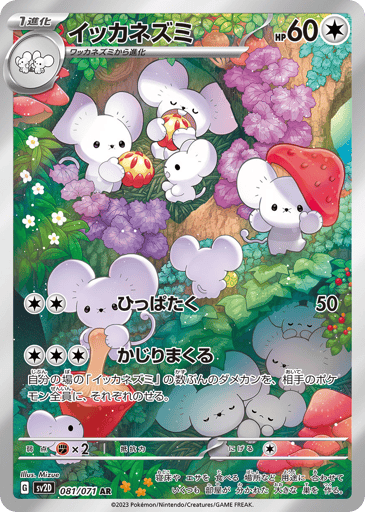
SV2D 081/071・2023 イッカネズミ AR
Maushold AR
SV2D 081/071 · Art Rare (AR)
Expansion “Clay Burst” (クレイバースト)
4 Japanese sales (7 days) · reference blends 8 variants
Japanese median sale price (ungraded)
HK$139
Find this card on Collect2Day ›What this card demonstrates
One of two older-set cards here, from 2023’s “Clay Burst”. HK$139 in Japan against HK$251, a gap of HK$112 or 45%. With older cards the hard part is usually not price but sourcing: local shops mostly stock current hits, and an older AR has to come out of Japan’s circulating pool. So the value here is partly the gap and partly simply finding one. 4 Japanese sales, 8 blended variants.
-
#7
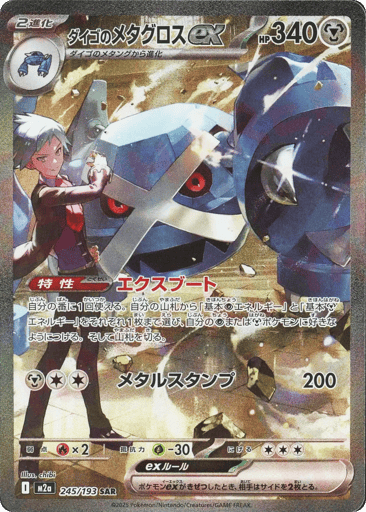
M2a 245/193・2025 ダイゴのメタグロスex SAR
Steven’s Metagross ex SAR
M2a 245/193 · Special Art Rare (SAR)
High class pack “MEGA Dream ex” (MEGAドリームex)
7 Japanese sales (7 days) · reference blends 8 variants
Japanese median sale price (ungraded)
HK$159
Find this card on Collect2Day ›What this card demonstrates
Last on gap at HK$110, 41% — but with 7 Japanese sales, more than the 3–4 behind the 1st, 2nd, 5th and 6th. Its median is therefore better supported than several cards above it: the smallest gap on the list sits on some of the firmest data, which is the reverse of what the ranking implies. It is a trainer-plus-Pokémon SAR, drawing on both fanbases, with a steady collector following. 8 blended variants.


Three questions for any cross-market comparison
FAQ
Where does the international reference come from?
It is a snapshot of listing prices from the international collector market, used as a proxy for global demand, medianed across several variants of the same card — eight for most cards here, twenty-four for the 4th. So it represents a range, not one sale and not one seller’s actual asking price.
Is the biggest gap the best buy?
Not necessarily. The 1st card has the largest gap on 3 Japanese sales; the 7th has the smallest gap on 7. The gap answers “how much cheaper”, the sale count answers “how trustworthy is that price”. Two separate questions.
What will it actually cost me?
The Japanese prices here exclude international freight and the proxy service fee, both of which are added on top. The real figure depends on weight, shipping method and how many items are in one order — the live quote on the Collect2Day page is the accurate one.
Buy direct from Japan on Collect2Day
Collect2Day connects you straight to the Japanese market and consolidates your order into one cross-border shipment — several cards in one order is how the freight gets spread.
Start searchingPrices are market reference figures, for comparison only; the Japanese prices exclude international freight and proxy service fees. Prices and exchange rates move; the quote shown on the Collect2Day page is the one that applies.