

A “Chinese-foil error” is a Japanese card whose foil stamping was struck with the Chinese-language type die. It is not damage and it is not a counterfeit — it is a variant you can only see by comparing it to a normal copy. Entry starts around ¥1,000. But that same card’s weighted average sale price this week was ¥2,604, 2.6× its median. Here is how to identify one, and why that ¥1,000 is not what it costs.
The short version
- Identify by typeface and embossing, not by looking for flaws. The entire difference sits in the foil-stamped type. The card itself is undamaged.
- When the median and the weighted average diverge, there is no market price. Card 1: median ¥1,000, weighted average ¥2,604. Cards 2 and 3, with thicker volume, sit 2% and 4% apart.
- The crowd is on the graded side. Cards 2 and 3 have 96 and 178 PSA 10 sales against 11 and 25 ungraded.
What an error card is, and what to compare it against
All three come from the high class pack “MEGA Dream ex” and share a rarity — Mega Attack Rare, numbered above the set’s 193-card base, already the deepest slot in the product. The error affects only the foil stamping: struck with the Chinese-language type die, so the illustration and the frame are identical to a normal copy and only the typeface and embossing of the foil text differ.
That determines how you check one. An error is not a defect — there is no tear, no misalignment, no blemish to point at — so the instinct to hunt for damage is useless here. The method is to set it beside a normal copy and compare the letterforms and the position of the embossing. The step people skip is having the comparison copy at all; seeing no difference usually means no reference, not a fake.
On price, the three ungraded medians run ¥1,000 to ¥3,000, which looks like a tidy entry ladder. But a median is only the middle of a pile of sales; it says nothing about how far apart those sales were. Each card below shows its median and this week’s weighted average together, because the distance between them is the signal that matters.
The three are ordered by ungraded median, lowest first. It is an entry ladder, not a ranking of quality.
Three MA errors, cheapest entry first
-
#1
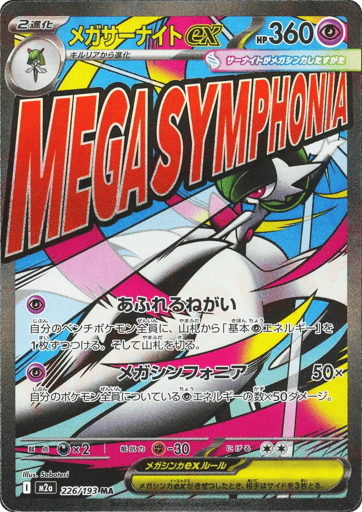
M2a 226/193・2025 メガサーナイトex MA (Chinese-foil error)
Mega Gardevoir ex, Chinese-foil error
M2a 226/193 · Mega Attack Rare (MA)
High class pack “MEGA Dream ex” (MEGAドリームex)
Weighted average this week ¥2,604 · 7 sales
Under 5 PSA 10 sales — the source withholds the graded row
30-day median (ungraded)
¥1,000
4-week trend (ungraded weighted average; sale count beneath)
Find this card on Collect2Day ›What this card demonstrates
The cheapest entry at a ¥1,000 median — and a weighted average this week of ¥2,604, 2.6× as much. That distance means the sales are scattered: under one card name, cheap trades and expensive trades are happening at the same time, whether from condition differences or different kinds of sale. The four-week trend lays it out — ¥1,000, ¥3,625, ¥1,000, ¥2,604 — on 2 to 7 sales a week. This week’s +160.4% compares 7 sales against the previous week’s 2; it measures the wobble in the sample, not a direction in the price. This card has no market price, only a very wide range. With fewer than 5 PSA 10 sales, the source withholds the graded row.
-
#2
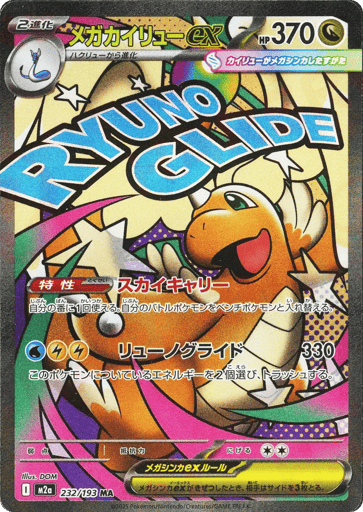
M2a 232/193・2025 メガカイリューex MA (Chinese-foil error)
Mega Dragonite ex, Chinese-foil error
M2a 232/193 · Mega Attack Rare (MA)
High class pack “MEGA Dream ex” (MEGAドリームex)
Weighted average this week ¥2,047 · 11 sales
30-day median (ungraded)
¥1,999
4-week trend (ungraded weighted average; sale count beneath)
Find this card on Collect2Day ›What this card demonstrates
A ¥1,999 median against a ¥2,047 weighted average — 2% apart, in sharp contrast to card 1. Eleven sales is still thin, but enough for the two averages to converge, which makes this price far more usable than the first. The interesting half is elsewhere: 96 PSA 10 sales, up 10.4% this week, the only double-digit gain of the three — while ungraded fell 15.5% over the same period. One card, two tiers, opposite directions.
-
#3
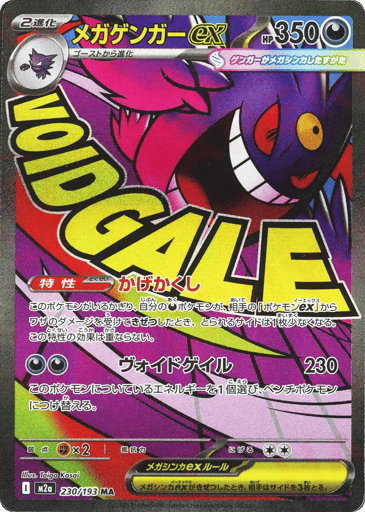
M2a 230/193・2025 メガゲンガーex MA (Chinese-foil error)
Mega Gengar ex, Chinese-foil error
M2a 230/193 · Mega Attack Rare (MA)
High class pack “MEGA Dream ex” (MEGAドリームex)
Weighted average this week ¥3,111 · 25 sales
30-day median (ungraded)
¥3,000
4-week trend (ungraded weighted average; sale count beneath)
Find this card on Collect2Day ›What this card demonstrates
The dearest entry: a ¥3,000 median against a ¥3,111 weighted average, 4% apart on 25 sales, the thickest ungraded volume of the three. Its 178 PSA 10 sales are nearly double card 2’s 96, the highest participation in this batch of errors. Put the two side by side and one thing stands out: identical printing defect, yet PSA 10 moved +0.7% here against +10.4% on card 2. The graded market is clearly picking characters within the error category rather than buying any error going. Ungraded, meanwhile, is down 32.8% this week, the steepest of the three — selling pressure at the cheap end lands on the unslabbed copies.
Three questions before buying an error card
FAQ
How does a Chinese-foil error happen?
The foil-stamping stage was run with the Chinese-language type die, so the foil text on a Japanese card carries Chinese-edition letterforms. Illustration, frame and card number are all identical to a normal copy; only that foil layer differs.
Are error cards always worth more than normal copies?
This piece has no normal-copy prices to compare against, so it cannot answer that. What it can show is that the error alone guarantees no premium: three cards from the same batch run ¥1,000 to ¥3,000 ungraded, and in PSA 10 this week one gained 10.4% while another gained 0.7%. The market is plainly choosing between them.
Why is there no PSA 10 data for the first card?
The source withholds the graded row when there are fewer than 5 PSA 10 sales. That is a data threshold rather than an omission — the graded market for this card is currently too thin to quote.
Does +160.4% mean this card is appreciating?
No. That figure compares this week’s weighted average across 7 sales with the previous week’s across 2. The same series had just fallen from ¥3,625 back to ¥1,000 the week before. At those sample sizes a percentage measures noise, not trend.
Browse MEGA Dream ex error cards on Collect2Day
Collect2Day connects you directly to the Japanese market and consolidates your order into one cross-border shipment. Read the seller’s condition and variant notes before ordering.
Start searchingPrices are reference figures from Japanese-market sales, for comparison only. Live prices move; the quote shown on the Collect2Day page is the one that applies.