
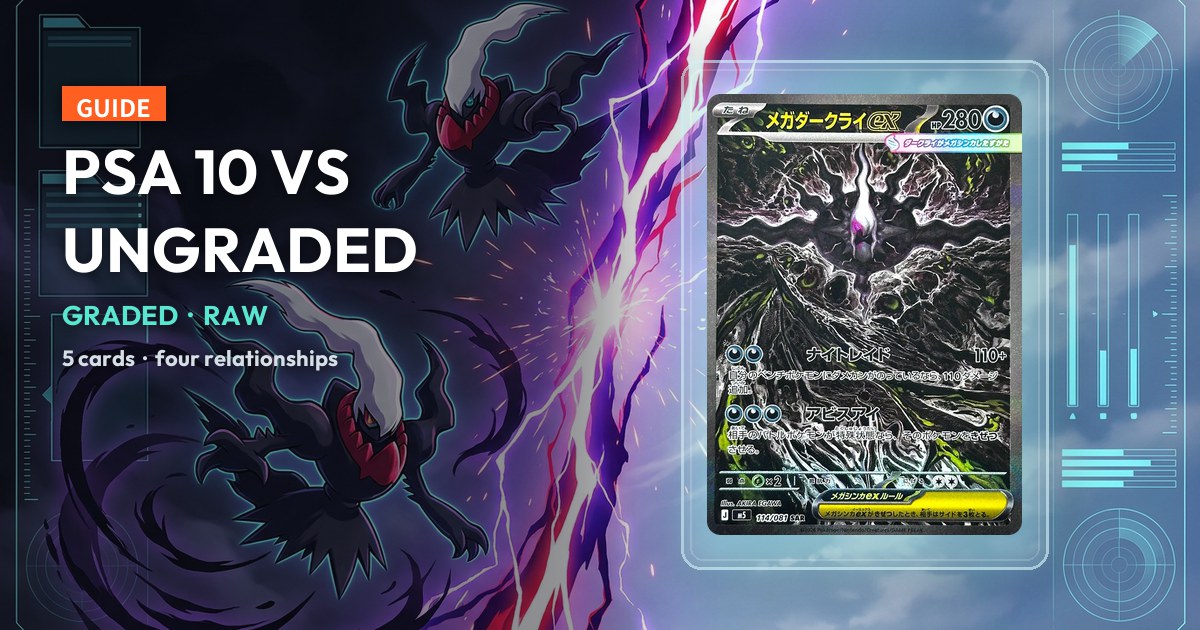
One dataset, one week: a card whose ungraded median fell 40.1% over 30 days, while its PSA 10 rose 1.8% in the same week. Another does the exact opposite — PSA 10 down 11.7% in a week against just 3.8% ungraded. Two more have no PSA 10 sales at all, so there is nothing to compare against. “Graded cards hold up better” sounds reasonable, and the five cards below produce four completely different relationships from a single dataset.
The short version
- Graded and ungraded are separately cleared markets. M5 114/081 fell 40.1% ungraded over 30 days while its PSA 10 rose 1.8% on the week — a ¥34,000 gap between the two tiers.
- PSA 10 can fall faster. The M-P 020 Pikachu’s PSA 10 dropped 11.7% in a week on 243 sales; ungraded fell only 3.8% over the same stretch. The opposite direction to the card above.
- Two more states show up at once. M5 117/081 and M5 115/081 have no PSA 10 sales whatsoever; M2a 223/193 has 224, but a ¥15,000 median against a ¥19,524 VWAP — skewed enough that the median alone misleads.
Why “PSA 10 holds up better” is not a rule
A card’s price is never one number. Ungraded (raw) and PSA 10 are two separately cleared markets: different buyers, different supply, different things setting the price. Treat them as upper and lower halves of one price line and you expect them to move together — and the data does not support that expectation.
The five cards below happen to cover four relationships. The first is the intuitive one: ungraded falls hard while PSA 10 stays firm or rises. The second is its mirror image, PSA 10 falling faster than raw. The third is no PSA 10 sales at all, so no graded reference price exists. The fourth is subtler — PSA 10 has sales, but the median and the volume-weighted average (VWAP) are far apart, meaning the distribution is skewed and the median understates how wide the real range is. For how large the grading premium itself runs, the PSA 10 premium guide measures it across ten cards.
One thing to settle first: a drop percentage needs a sale count before it means anything. The thinnest group below rests on 5 ungraded sales, the thickest on 243 PSA 10 sales, and those two are not in the same class of reliability. That argument is made in full in reading a price drop; this post takes the other question — which tier the drop belongs to.
The last angle only appears if you track the same card twice. M5 114/081 sits in that same guide at a ¥37,000 ungraded median, with PSA 10 at ¥68,000 and −27.4% on the week. A week later it is ¥30,000 ungraded, with PSA 10 at ¥64,000 and +1.8% on the week. Same card, same graded tier, direction reversed inside seven days. Which is exactly why “PSA 10 holds up” cannot be treated as a property of a card. It is a state, and states change.
Five cards, four graded-to-ungraded relationships
-
#1
M5 114/081・2026 Mega Darkrai ex SAR
メガダークライex · no official Chinese name confirmed
M5 114/081 · Special Art Rare (SAR)
拡張パック「アビスアイ」
Abyss Eye (expansion)
30d −40.1%
30-day median (ungraded)
¥30,000
4-week trend (ungraded VWAP; sale count beneath)
Search this card on Collect2Day ›What this card demonstrates
The clearest contrast in this list. Ungraded median ¥30,000, VWAP ¥30,025, on 51 sales; down 40.1% over 30 days, and still −10.0% counting this week alone. Over the same stretch PSA 10 sits at a ¥64,000 median, ¥63,968 VWAP, 63 sales, up 1.8% on the week. Both sides carry real volume, so this is not an artefact of a thin sample, and the ¥34,000 gap between the tiers is genuinely there. Why would one fall while the other rises? The usual explanation is that ungraded supply concentrates during a set’s opening period while grading costs time and money — but there is no grading-submission or shipment data here to test that, so it stays one explanation and not a conclusion.
-
#2
M5 117/081・2026 ムク SAR
A Supporter (Trainer) card, not a Pokémon
M5 117/081 · Special Art Rare (SAR)
拡張パック「アビスアイ」
Abyss Eye (expansion)
30d −48.3%
30-day median (ungraded)
¥4,400
4-week trend (ungraded VWAP; sale count beneath)
Search this card on Collect2Day ›What this card demonstrates
The deepest fall in this list: −48.3% over 30 days, deeper than the Mega Darkrai ex from the same set. Ungraded median ¥4,400, VWAP ¥4,338, 22 sales — though it is already +1.7% this week, so the short run is not a continued slide. What separates it from the other four is having no PSA 10 sales at all: the market is pricing it on the ungraded tier alone, with no graded reference to compare against. Worth flagging too: this is not a Pokémon card but a Supporter (Trainer) SAR with a full-figure illustration, and it is unrelated to the Starly / Staravia / Staraptor evolution line despite the similar name. No official Chinese name is confirmed, so the Japanese name is authoritative here.
-
#3
M5 115/081・2026 Morpeko ex SAR
モルペコex · no official Chinese name confirmed
M5 115/081 · Special Art Rare (SAR)
拡張パック「アビスアイ」
Abyss Eye (expansion)
30d −31.7%
30-day median (ungraded)
¥3,800
4-week trend (ungraded VWAP; sale count beneath)
Search this card on Collect2Day ›What this card demonstrates
The thinnest of the three Abyss Eye SARs: just 7 sales, −31.7% over 30 days, but only −0.5% this week — essentially flat. The ¥3,800 median and ¥3,799 VWAP almost coincide, which means no outlying high sale is lifting the average and no unusually cheap dump is dragging it down: a very thin but very honest price. Samples this small have one characteristic worth knowing — a single unusually clean copy is enough to move the whole median — so the corners and centring of the actual copy matter more than the number does. It has no PSA 10 sales either.
-
#4
M2a 223/193・2025 Mega Charizard X ex MA (Chinese foil error)
メガリザードンXex · Chinese hot-foil error print
M2a 223/193 · Mega Attack Rare (MA)
ハイクラスパック「MEGAドリームex」
MEGA Dream ex (high-class pack)
30d −29.5%
30-day median (ungraded)
¥5,500
4-week trend (ungraded VWAP; sale count beneath)
Search this card on Collect2Day ›What this card demonstrates
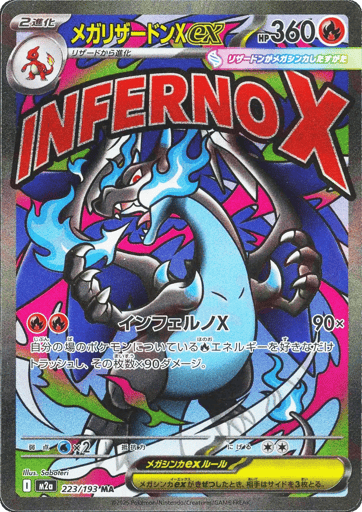
This one demonstrates the fourth state: PSA 10 has sales, but its median and its volume-weighted average are far apart. The PSA 10 median is ¥15,000 while the VWAP is ¥19,524, across 224 sales — meaning a cluster of sales well above the median is pulling the average up, and the distribution is badly skewed. Buy off the median alone and it is easy to underestimate how wide the real range is. The ungraded side is the reverse: only 5 sales, the thinnest group here, at a ¥5,500 median and ¥5,720 VWAP, +2.1% this week and −29.5% over 30 days — thin enough to be a reference only. It is the Chinese hot-foil error print, and with error cards the foil placement and detail on the actual copy are what matter, so check the real photographs before ordering. For where this class of error card comes from, see the Chinese foil error cards guide.
-
#5
M-P 020・2025 Pikachu P
ピカチュウ promo · McDonald’s Happy Set 2025
M-P 020 · Promo (Mega Evolution Promos)
プロモカードパック「マクドナルド ハッピーセット2025」
McDonald’s Happy Set 2025 promo pack
30d −32.2%
30-day median (ungraded)
¥3,680
4-week trend (ungraded VWAP; sale count beneath)
Search this card on Collect2Day ›What this card demonstrates
The closing card pushes this post’s argument as far as it goes: PSA 10 fell faster than ungraded. PSA 10 is down 11.7% on the week at a ¥12,480 median and ¥13,165 VWAP, across 243 sales — the steepest graded fall here and also the thickest volume, so it cannot be waved away as thin-sample noise. Ungraded over the same stretch is down just 3.8%, at a ¥3,680 median and ¥3,744 VWAP on 11 sales, −32.2% over 30 days. The exact opposite direction to card 1. Why the inversion? There is no grading-submission or distribution data here, so this post does not guess at a cause and states only what the prices show: ungraded and PSA 10 are two markets running on different rhythms, and they need reading separately.



Three questions to ask of any drop
Frequently asked
Does a PSA 10 always hold value better than a raw card?
No. Card 1 here matches that expectation — ungraded −40.1% over 30 days against PSA 10 +1.8% on the week — but card 5 inverts it: PSA 10 −11.7% on the week against ungraded −3.8%, and the PSA 10 figure rests on 243 sales, so it is not a thin sample. Holding up is a state that changes, not a fixed property of a card.
Why do some cards have no PSA 10 price?
Because there are not enough PSA 10 sales to publish one. Cards 2 and 3 here have no graded sales at all, so no graded price exists to compare. The source hides the graded column below 5 sales, and shows a median without a change figure below 10.
What is the difference between a median and a VWAP?
The median is the middle sale price; the VWAP is the volume-weighted average. When they are close, sales are clustered in one band. When they diverge, the distribution is skewed — as with card 4’s PSA 10 here.
Can these drops be used to predict where prices go next?
This post makes no prediction. These figures describe sales that have already happened, and the sale count behind each one varies enormously. They are useful for judging where the current price sits, not for extrapolating the next move.
Compare live stock on Collect2Day
Collect2Day connects directly to the Japanese market, so you buy at local Japanese prices and consolidate everything into one cross-border shipment.
Search Pokémon cardsPrices here are reference figures from Japanese-market sales, quoted in yen, and are for comparison only. Live pricing moves; the figure on the Collect2Day page is the one that applies.