

Take one card. How much more does it sell for in a PSA 10 slab than raw? That gap is the PSA 10 grading premium. Across the ten Japanese-market cards below it runs from ¥1,617 down to ¥96. It looks like a list of grading candidates. The more useful reading is the opposite one: a premium is a gross spread, not a profit — and on most of these ten it does not cover the cost of grading at all.
The short version
- The spread runs ¥96 to ¥1,617. Widest is リーリエのピッピex SAR-spec (MC 765/742); narrowest is メガルチャブルex SAR (M2a 239/193).
- Premium is not profit. Grading fees, round-trip shipping, waiting time and the risk of not getting a 10 all come out of that number.
- Multiples flatter small cards. ¥58 to ¥153 is 2.6× — and ¥96 in cash, computed from three sales.
What the grading premium is
Raw — or ungraded — means the card itself, never submitted to a third-party grader. PSA 10 means that same card sent to PSA, awarded the top grade, and sealed in a graded holder. They are different products that trade separately, and the difference between their median prices is the grading premium.
What matters is what kind of number that is: a price difference between two states of the same card, not the money you make by submitting one. Getting a PSA 10 requires the card to actually grade a 10, and no grading outcome is guaranteed in advance. The ten below are ordered by premium, widest to narrowest, all Japanese market in yen with no currency conversion.
Ten cards, in full
-
#1
MC 765/742 リーリエのピッピex SAR仕様
premium ¥1,617
MC 765/742
27 ungraded sales
Ungraded median
¥3,115
Find this card on Collect2Day ›What to notice here
The widest premium here at ¥1,617. Twenty-seven ungraded sales makes this one of the thicker raw samples, but the PSA 10 side carries the same uniform 11 as every other row. This is the only premium here clearly above a typical single-card submission cost.
-
#2
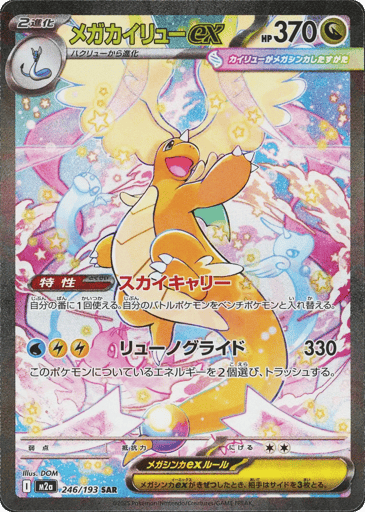
M2a 246/193 メガカイリューex SAR
premium ¥557
M2a 246/193
7 ungraded sales
Ungraded median
¥1,294
Find this card on Collect2Day ›What to notice here
¥557, second widest. Note the raw side has only seven sales, so the median is easily moved by an individual transaction.
-
#3
MC 760/742 ボスの指令(カラスバ) SR仕様
premium ¥443
MC 760/742
10 ungraded sales
Ungraded median
¥383
Find this card on Collect2Day ›What to notice here
¥443 — but on a ¥383 card. Submitting a low-priced card means fees and round-trip shipping eat the whole spread unless you batch enough of them together.
-
#4
MC 743/742 エリカのモンジャラ AR仕様
premium ¥398
MC 743/742
4 ungraded sales
Ungraded median
¥393
Find this card on Collect2Day ›What to notice here
¥398, but only four ungraded sales, one of the thinnest samples here. Both sides are thin, so treat this premium as a rough indicator.
-
#5
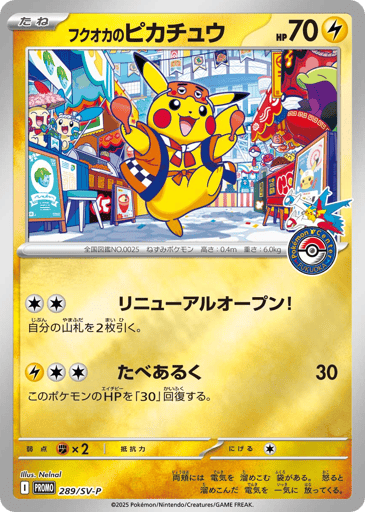
SV-P 289 フクオカのピカチュウ P
premium ¥394
SV-P 289
29 ungraded sales
Ungraded median
¥671
Find this card on Collect2Day ›What to notice here
¥394. Twenty-nine ungraded sales makes this the second-thickest raw sample, so the ungraded median is comparatively reliable.
-
#6
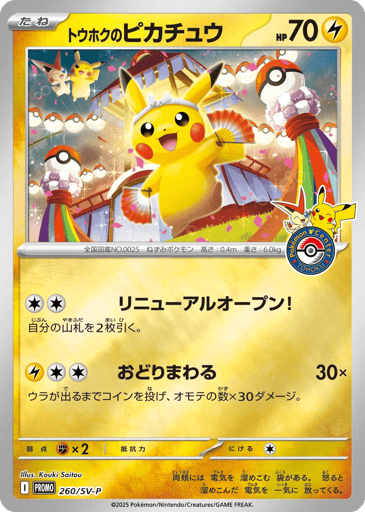
SV-P 260 トウホクのピカチュウ P
premium ¥284
SV-P 260
42 ungraded sales
Ungraded median
¥551
Find this card on Collect2Day ›What to notice here
¥284. Forty-two ungraded sales, the most here, meaning the median rests on more transactions. Same series as the card above, so the two compare directly.
-
#7
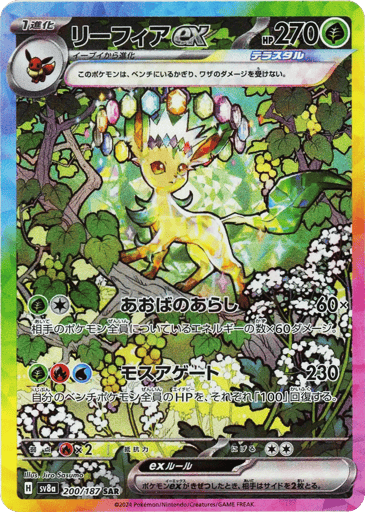
SV8a 200/187 リーフィアex SAR
premium ¥211
SV8a 200/187
5 ungraded sales
Ungraded median
¥393
Find this card on Collect2Day ›What to notice here
¥211 on only five ungraded sales — a thin sample. Read the rough range rather than fixing on the median.
-
#8
M2a 242/193 Nのゾロアークex SAR
premium ¥160
M2a 242/193
11 ungraded sales
Ungraded median
¥312
Find this card on Collect2Day ›What to notice here
¥160, on eleven ungraded sales. The cash premium has now fallen below the scale of a single-card submission cost.
-
#9
M1L 087/063 メガフシギバナex SAR
premium ¥140
M1L 087/063
6 ungraded sales
Ungraded median
¥311
Find this card on Collect2Day ›What to notice here
¥140 on six ungraded sales. At this premium, submitting a single card does not work arithmetically.
-
#10
M2a 239/193 メガルチャブルex SAR
premium ¥96
M2a 239/193
3 ungraded sales
Ungraded median
¥58
Find this card on Collect2Day ›What to notice here
¥96, the narrowest, on the lowest raw median here at ¥58. As a multiple, ¥58 to ¥153 looks dramatic — but there are only three ungraded sales behind it, the thinnest sample in the set, so the ratio is not a conclusion.



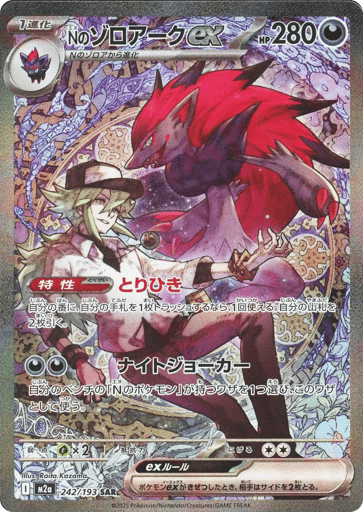
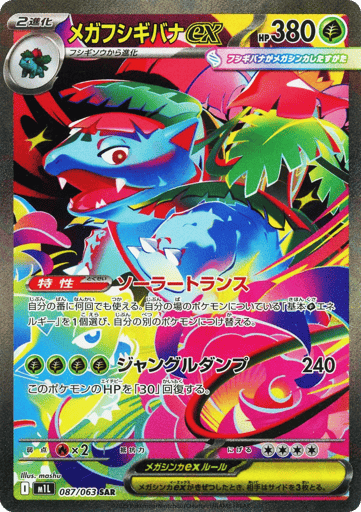
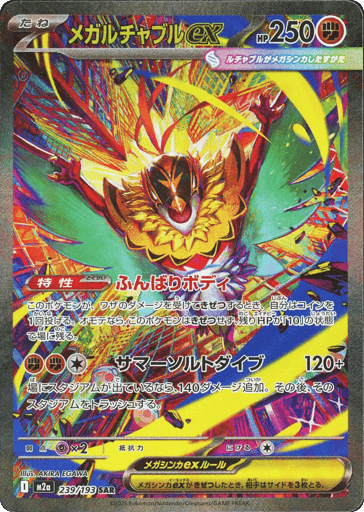
Japanese names are kept as printed. Only three cards here have an official translated name in the source data; the rest are left in Japanese rather than translated by guesswork. Either way, what identifies a card uniquely is the set code plus number.
Premium is not profit
This is where the table is most easily misread. The premium is a spread between two states, and turning a raw card into a PSA 10 costs at least four things:
Put those back against the table. Number 10 carries a ¥96 premium — on any cross-border submission that almost certainly fails to cover the grading fee alone. Number 3’s ¥443 is the same shape of problem: it is a ¥383 card. The smaller the cash premium, the larger the share fixed costs take, regardless of how impressive the multiple looks.
Three limits on this data
- Every PSA 10 sale count is exactly 11, on all ten cards. That is suspiciously tidy — most likely a query cap or an unverified placeholder. The graded medians and therefore every premium above should be treated as a rough reference rather than a firm figure. This is the single most important caveat on the page.
- Raw sample depth varies enormously — 42 sales (SV-P 260) down to 3 (M2a 239/193). Below about five sales a median can be dragged by one or two transactions.
- No time window, no price distribution, no week-on-week change. This data carries medians and sale counts only, so nothing here claims a price is holding, and nothing forecasts.
FAQ
Is the widest premium the best card to submit?
The premium is only one side of the equation. Number 1’s ¥1,617 is the only figure here clearly above a typical single-card submission cost, and it still has round-trip shipping and grade risk to absorb — and its PSA 10 median carries the same 11-sale caveat as the rest.
Why look at the cash spread instead of the multiple?
Because costs are charged in cash. Number 10 goes from ¥58 to ¥153, which looks dramatic as a multiple, but the actual spread is ¥96 — and grading fees do not shrink because a ratio is flattering.
Why is there no PSA 9 column?
The source data does not carry it. Every premium here is quoted against PSA 10, and a 9 sits in a different price tier — which is why ‘the risk of not getting a 10’ is listed as its own cost.
Find these cards on Collect2Day
Collect2Day buys direct from the Japanese market, so you pay Japanese prices and ship everything home in one consolidated parcel.
Start searchingPrices here are reference medians from Japanese market sales and are for comparison only. Live pricing moves; the figure on the Collect2Day page is the one that applies.