

One Pokémon, three cards, and a 2.5× spread: ¥4,799 at the top and ¥1,900 at the bottom. All three are Ditto, drawn from three Japanese-market sets released in 2018, 2022 and 2023. The detail worth noticing first is that the only one of the three numbered beyond its set’s base count is also the cheapest. So what sets the rung is not how rare the slot is — it is a few more specific things. Here is each card, with one caveat stated up front: these three have only 3 to 6 ungraded sales each over 30 days.
The short version
- Numbering position does not order these prices. S12A 197/172 (¥1,900) is the only card here numbered past its set’s base count, and it is the cheapest; the dearest, SV2A 132/165, sits inside the base list.
- The print treatment is the variable. The ¥4,799 card is the Master Ball mirror from Pokémon Card 151 — same illustration as the standard print, with the card’s foil pattern replaced by Master Ball motifs.
- All three medians rest on 3 to 6 sales. Read them as three reference rungs, not as market prices.
Why one Ditto can cost 2.5× another
A card’s sale price usually reflects three things at once: which print treatment it carries, which set it belongs to, and how many people collect that set. They are independent of each other, which is how different versions of the same Pokémon end up wildly out of proportion.
Start by ruling out the intuitive explanation. The denominator in a card’s number is its set’s base count, so a card numbered above it sits outside the base collecting list and appears at a lower rate — which is exactly where card 3, S12A 197/172, sits. It is also the cheapest of the three. Card 1, SV2A 132/165, is inside its set’s 165 and is the dearest. Ranked by numbering position alone, the order simply does not hold.
That leaves the print treatment and the set. The three below happen to cover three different cases: a special-foil parallel from a popular set, a card from a six-year-old set, and an illustration card numbered past the base count of a high-class pack. For the difference between a redrawn illustration and a material upgrade, see SAR vs UR vs CSR.
Last comes the sample size, and it matters more than any of the above for how these three numbers should be read. Each has only 3 to 6 ungraded sales in 30 days, and the source’s filter floor is a mere 3 ungraded sales in 90 days. Sale count is what decides how much a median can carry — a point covered at length in how to read a price drop. In single digits, one unusually clean or unusually rough copy is enough to move the median outright.
The three versions, dearest first
-
#1
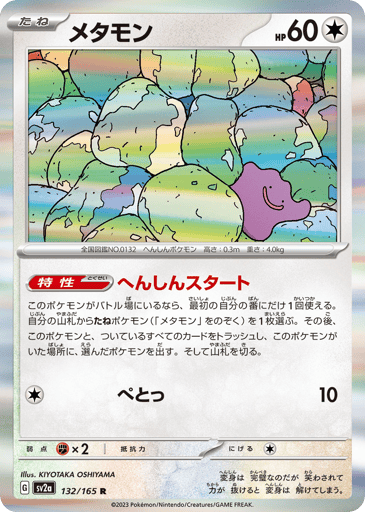
SV2A 132/165・2023 Ditto — Master Ball Mirror
Master Ball mirror parallel
SV2A 132/165 · R · Master Ball mirror (マスターボールミラー)
強化拡張パック「ポケモンカード151」
Pokémon Card 151 (enhanced expansion)
No. 132, inside this set’s base list of 165
30-day median (ungraded)
¥4,799
Search this card on Collect2Day ›What this card demonstrates
The dearest of the three at a ¥4,799 median. This is the Master Ball mirror from Pokémon Card 151: the illustration is the same as the standard print, and the difference is the foil — the card’s background pattern is replaced with Master Ball motifs. So it is a parallel print treatment, neither a newly drawn illustration nor a slot past the base numbering (132 sits comfortably inside the set’s 165). Its place at the top is plausibly explained by that treatment plus how heavily this particular set is collected; there is no print-run or supply data here to test that, so it stays an explanation rather than a conclusion.
-
#2
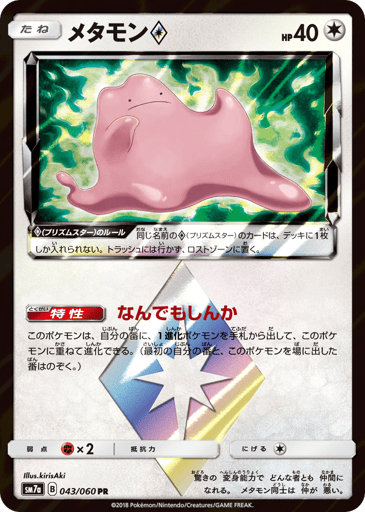
SM7A 043/060・2018 Ditto — PR
From the 2018 Thunderclap Spark set
SM7A 043/060 · Labelled PR by the source — see the note
拡張パック「迅雷スパーク」
Thunderclap Spark (expansion)
No. 043, inside this set’s base list of 060
30-day median (ungraded)
¥2,800
Search this card on Collect2Day ›What this card demonstrates
A ¥2,800 median, in the middle. This is the Ditto from 2018’s Thunderclap Spark, four years older than card 3, and its job here is to rule out the assumption that newer cards cost more. An older set means circulating supply has stopped growing, but it also means attention has faded; the two forces pull in opposite directions, so the year on its own predicts nothing. One thing to flag: the source labels this card PR, for promo, while its number 043/060 places it inside the set’s base count — the two do not quite agree. The source’s label is kept here and the tension named, because when identifying this card the number and set are the more reliable handle.
-
#3
S12A 197/172・2022 Ditto — AR
Numbered past the base count
S12A 197/172 · AR, Art Rare (アートレア)
ハイクラスパック「VSTARユニバース」
VSTAR Universe (high-class pack)
No. 197, past this set’s base count of 172
30-day median (ungraded)
¥1,900
Search this card on Collect2Day ›What this card demonstrates
A ¥1,900 median, the cheapest of the three — and the only one numbered beyond its set’s base count, 197 against 172. That is this guide’s central comparison: if sitting outside the base list meant being worth more, this card would not be last. It comes from the VSTAR Universe high-class pack, and packs of that kind are built around large numbers of above-base cards, so the position is not especially scarce within this set. If the goal is a Ditto at the lowest of the three prices, this is the entry rung.

Three questions worth asking about these prices
Frequently asked
What does a Ditto card cost?
For the three versions in this guide, ungraded medians run ¥1,900 to ¥4,799. Note that this covers only versions with at least 3 ungraded sales in the past 90 days, so it is not the full price range of every Ditto card.
What is a Master Ball mirror?
A foil parallel treatment found in the Pokémon Card 151 set: the illustration matches the standard print, and the card’s background pattern is replaced with Master Ball motifs. It is a difference in printing, not a separately drawn illustration.
Why does a 2018 card cost more than a 2022 one?
Card 2 here, from 2018, has a ¥2,800 median against ¥1,900 for card 3 from 2022. The plausible reading is that print treatment and set structure outweigh the year. That is an inference from the prices themselves — there is no print-run or supply data here to confirm it.
How reliable are these three prices?
Treat them as reference points. Each card has only 3 to 6 ungraded sales over 30 days, and the filter floor is 3 sales in 90 days. Prices are ungraded medians with one-off outliers removed, but on samples this thin a median is still easily moved by a couple of sales.
Find Ditto cards on Collect2Day
Collect2Day connects directly to the Japanese market, so you buy at local Japanese prices and consolidate everything into one cross-border shipment.
Search Ditto cardsPrices here are reference figures from ungraded Japanese-market sales, quoted in yen, and are for comparison only. Live pricing moves; the figure on the Collect2Day page is the one that applies.