
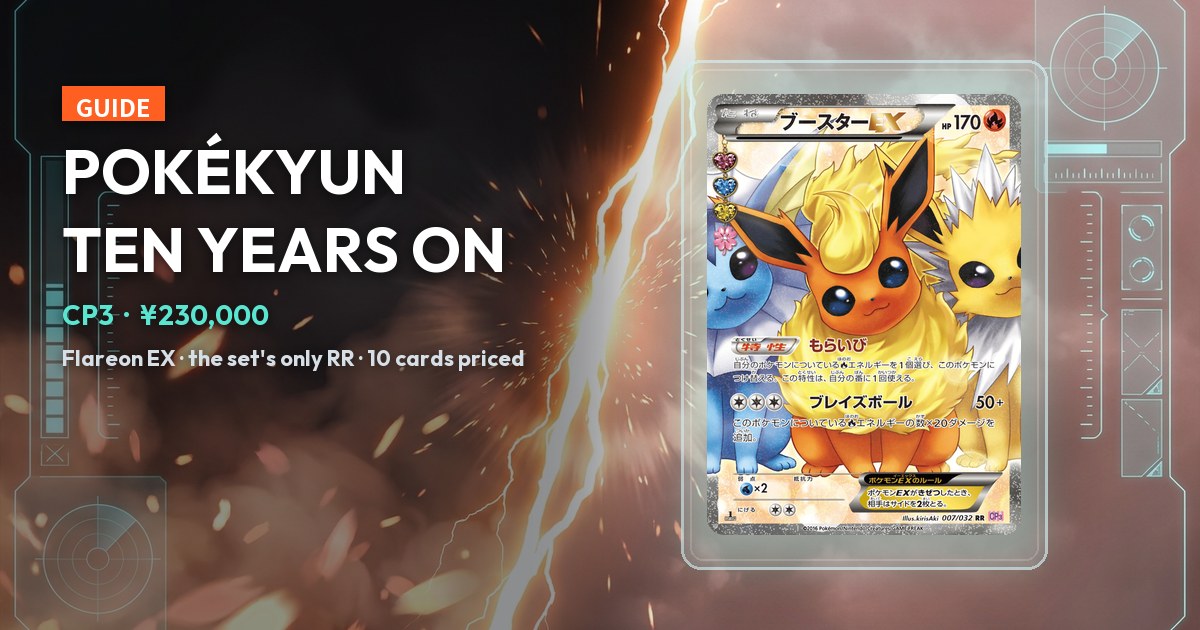
Pokékyun Collection (CP3), the concept pack released in January 2016, holds just 32 cards — and every single one of them is a 1st Edition print. Ten years on, ten of those cards have enough completed sales in the Japanese market over the last 180 days to carry a reference price. Lined up highest to lowest they show something characteristic of old sets: the rarity letter on the card does not put the prices in order.
The short version
- All 1ED, so there is no print run to compare. Every one of CP3’s 32 cards was released as a 1st Edition, so there is no “first print costs more” tier inside the set — the premium belongs to the whole thing.
- The rarity letter does not order the prices. A Common (Raichu at ¥14,000) sits above two Uncommons, and the Uncommon tier by itself runs from ¥28,000 all the way down to ¥2,500.
- Read the sale count before the price. Only Dedenne has a thick sample — 16 sales — and its median and weighted average are the closest pair in the set, which makes it the one card worth using as a benchmark.
In an all-1ED set, what actually sets the price?
Start with what CP3 is. A concept pack released on 29 January 2016, 32 cards, built around cute illustration rather than competitive strength. Its distinctive structural condition is that every card in it was released as a 1st Edition. In most lines 1ED is a variable you can price against — the same card costs more as a 1ED than as an unmarked reprint. In CP3 it is a constant, so any price difference inside the set has to be explained by something else.
The ten cards below are the ones with enough completed sales in the last 180 days to give a reference price — not all 32. That is itself normal for an old set: for a ten-year-old release most numbers cannot muster three sales in six months, and without sales there is no price, only an asking price.
Line the ten up highest to lowest and the rarity ordering breaks immediately. The dearest card, Flareon EX, is the set’s only Double Rare at ¥230,000, which makes sense. But the nine beneath it are all Uncommon or Common and their order has nothing to do with the letter: fifth-placed Raichu is a Common at ¥14,000, above sixth-placed Altaria (Uncommon, ¥11,000) and above last-placed Froslass (Uncommon, ¥2,500). The Uncommon tier alone runs from ¥28,000 to ¥2,500, and three Commons — Espurr at ¥7,000, Wobbuffet at ¥5,000, Swablu at ¥4,000 — all sit above that Uncommon too.
What is doing the ordering is the character. Second-placed Charizard is only an Uncommon yet holds the top spot under the Double Rare, because the character’s pull already outweighs the rarity mark on the card. Third-placed Dedenne and fifth-placed Raichu are two halves of the same electric-rodent collecting line and land next to each other. Sixth-placed Altaria and ninth-placed Swablu are an evolution pair, numbered 029 and 028 so that CP3 puts them side by side — and collectors mostly hunt the two together.
As for using these prices: every card below carries its weighted average and its sale count, because a median on its own tells you nothing about how steady it is. Across the ten, the weighted average sits above the median on six cards, below it on three, and exactly on it for one — and the two that diverge furthest, Raichu and Altaria, both rest on only 4 sales. If you want one number to price against, Dedenne is the pick: 16 sales, with a ¥19,000 median and a ¥18,719 weighted average that all but overlap, which means buyers and sellers have converged on what it is worth. How to read those two numbers is covered in full in the piece on Chinese-foil error cards; here they are just the tool.
Ten cards: the 180-day median, the weighted average, and the sales behind each
-
#1
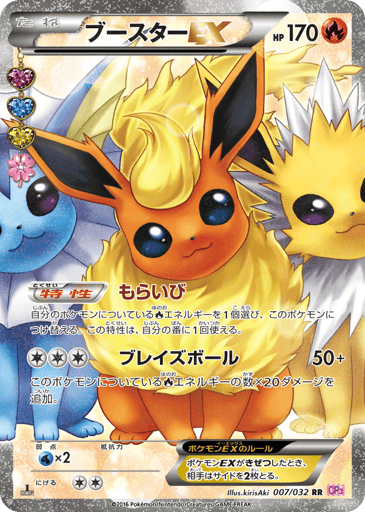
CP3 007/032・2016 ブースターEX RR :1ED
Flareon EX
CP3 007/032 · Double Rare (RR)
Pokékyun Collection (ポケキュンコレクション)
1ED
180-day median sale price (ungraded)
¥230,000
Find this card on Collect2Day ›How to read this price
The set’s only Double Rare, and the absolute top of the price range: a ¥230,000 ungraded 180-day median with a ¥240,000 weighted average. Read it together with the count, though — only 3 sales, so the figure describes a thin “priced when available” market rather than a street price you can go and pay. CP3 in 2016 was built around cute illustration and the popularity of the Eevee family, and Flareon has always had a committed following inside that group. Add the all-1ED condition and it is at once the most memorable card in the set and the hardest to complete one with.
-
#2
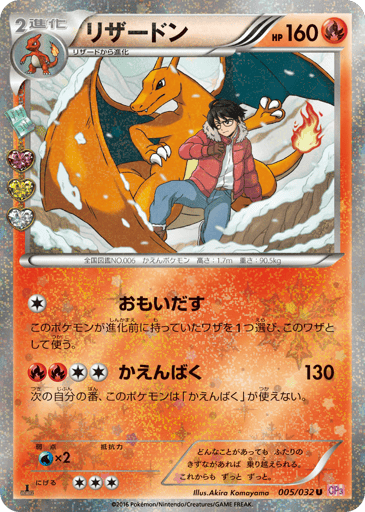
CP3 005/032・2016 リザードン U :1ED
Charizard
CP3 005/032 · Uncommon (U)
Pokékyun Collection (ポケキュンコレクション)
1ED
180-day median sale price (ungraded)
¥28,000
Find this card on Collect2Day ›How to read this price
The clearest illustration of this article’s point: only an Uncommon, yet it holds the top spot beneath the Double Rare. A ¥28,000 ungraded median with a ¥28,500 weighted average — the two sit close — and 8 sales, on the heavier side for this group, so the price stands relatively firm. “Low rarity, price holds anyway” is close to the norm for Charizard: the character’s pull already outweighs the rarity mark on the card. For plenty of collectors a CP3 Charizard is the entry ticket to the whole set.
-
#3
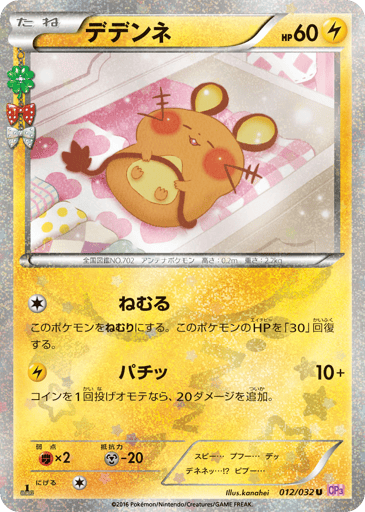
CP3 012/032・2016 デデンネ U :1ED
Dedenne
CP3 012/032 · Uncommon (U)
Pokékyun Collection (ポケキュンコレクション)
1ED
180-day median sale price (ungraded)
¥19,000
Find this card on Collect2Day ›How to read this price
If you only remember one card, remember this one. 16 sales, the most here, with a ¥19,000 median and a ¥18,719 weighted average that all but overlap. Two numbers that close mean the sales are clustered in one band and buyers and sellers have converged on the value — which makes this the best card in the piece to price against, rather than one that individual condition can drag around. Number 012/032, Uncommon. The electric-rodent line has a collecting thread of its own, and a concept pack led by illustration is exactly where that kind of character lands well.
-
#4
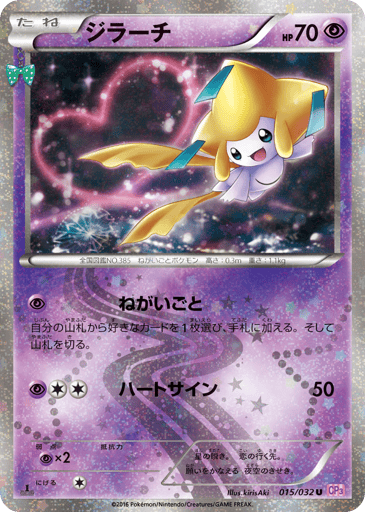
CP3 015/032・2016 ジラーチ U :1ED
Jirachi
CP3 015/032 · Uncommon (U)
Pokékyun Collection (ポケキュンコレクション)
1ED
180-day median sale price (ungraded)
¥15,000
Find this card on Collect2Day ›How to read this price
This one demonstrates what a weighted average below the median means: ¥15,000 median, ¥14,167 weighted average, 9 sales. The average sitting lower says the money is concentrated on the cheaper side — the larger transactions mostly went below the median — so reading ¥15,000 alone overestimates it. Jirachi is a Mythical Pokémon, which brings its own interest to a set in any era, and a concept pack led by illustration and mood is where a wish-themed character does best. 9 sales is a lot for this group, so this price is not propped up by an isolated case.
-
#5
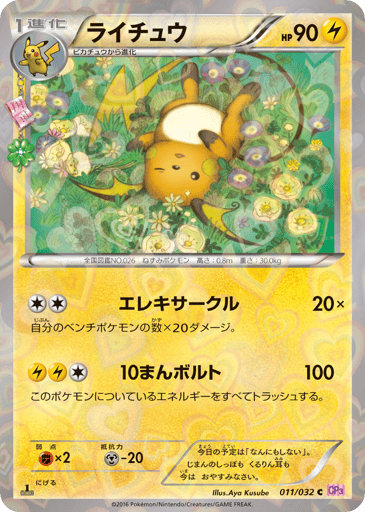
CP3 011/032・2016 ライチュウ C :1ED
Raichu
CP3 011/032 · Common (C)
Pokékyun Collection (ポケキュンコレクション)
1ED
180-day median sale price (ungraded)
¥14,000
Find this card on Collect2Day ›How to read this price
The card that most thoroughly breaks reading price off the rarity letter: only a Common, yet a ¥14,000 median that beats Altaria (Uncommon, ¥11,000) and Froslass (Uncommon, ¥2,500). More notable still, the ¥16,125 weighted average sits above the median on only 4 sales — which says individual high sales pulled the average up, a shape usually tied to condition and storage. So one number will mislead you on this card; read it with the count. On the character side, Raichu is one of the original electric types and forms a complete electric-rodent line with Dedenne inside CP3 — plenty of people hunt the pair together.
-
#6
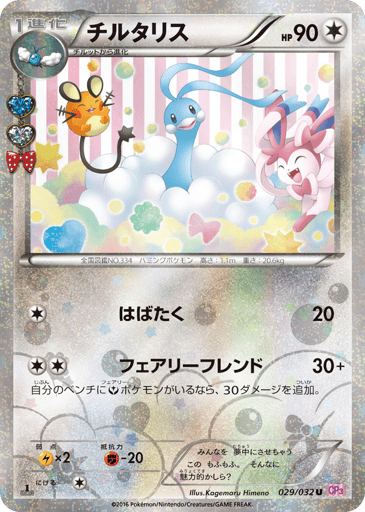
CP3 029/032・2016 チルタリス U :1ED
Altaria
CP3 029/032 · Uncommon (U)
Pokékyun Collection (ポケキュンコレクション)
1ED
180-day median sale price (ungraded)
¥11,000
Find this card on Collect2Day ›How to read this price
The same shape as Raichu: a ¥12,250 weighted average above a ¥11,000 median, on only 4 sales. The two cards whose numbers diverge furthest in this piece are both among the thinnest samples, which is not a coincidence. Number 029/032, near the end of the set, Uncommon. What makes it interesting is that it forms an evolution pair with 028 Swablu, and CP3 numbers the two together — a very clear collecting unit for anyone who likes buying in groups. The cotton-candy bird line is a signature subject for a cute-art concept pack, working through mood rather than through a character’s swagger.
-
#7
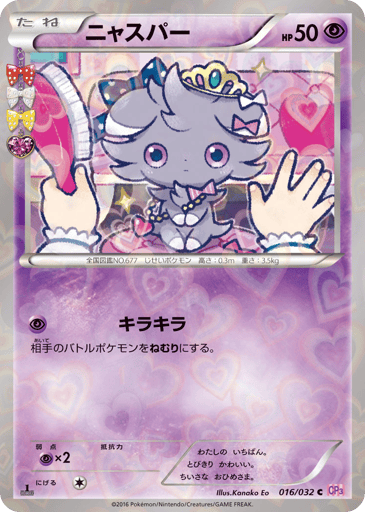
CP3 016/032・2016 ニャスパー C :1ED
Espurr
CP3 016/032 · Common (C)
Pokékyun Collection (ポケキュンコレクション)
1ED
180-day median sale price (ungraded)
¥7,000
Find this card on Collect2Day ›How to read this price
The cleanest numbers here: a ¥7,000 median and a ¥7,000 weighted average, exactly identical, on 3 sales. Two numbers that match mean every sale landed in the same band, with no unusually high or low transaction distorting the reference — genuinely useful if you want a clean baseline. Three sales is still a thin sample, though: the overlap says those three agreed, not that the card moves often. The character is not among the set’s most popular and the card is only a Common, so its value comes more from CP3’s all-1ED set property — even a common card has a floor in an old-set market.
-
#8
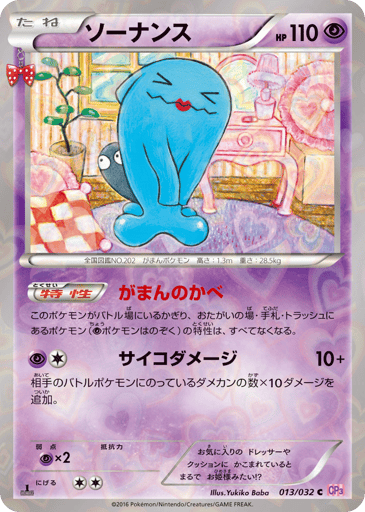
CP3 013/032・2016 ソーナンス C :1ED
Wobbuffet
CP3 013/032 · Common (C)
Pokékyun Collection (ポケキュンコレクション)
1ED
180-day median sale price (ungraded)
¥5,000
Find this card on Collect2Day ›How to read this price
Into CP3’s entry tier: a ¥5,000 median, a ¥5,333 weighted average, 3 sales. The average slightly above the median is not a strong signal on a sample that small — it just says trading at this level is sporadic. This card’s appeal is direct: the pose and the expression are the joke, and in a set built on cute and playful illustration it is one of the few that holds its place on humour rather than on looking impressive or being rare. For anyone starting a CP3 set, cards at this level are usually the first targets, because they are what decides whether you finish.
-
#9
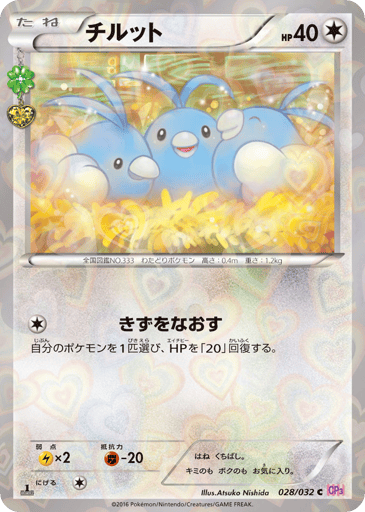
CP3 028/032・2016 チルット C :1ED
Swablu
CP3 028/032 · Common (C)
Pokékyun Collection (ポケキュンコレクション)
1ED
180-day median sale price (ungraded)
¥4,000
Find this card on Collect2Day ›How to read this price
The pre-evolution of the Altaria above: a ¥4,000 median, a ¥3,833 weighted average, 3 sales. Read alongside 029 it shows a very typical CP3 collecting logic — the price gap between the two evolution stages is small, but you need both for the group to be complete, so the same buyers mostly hunt them together. It is a Common and among the cheaper cards here, while still benefiting from the set’s all-1ED structure. It holds a place among the ten with a 180-day reference price, so it does circulate.
-
#10
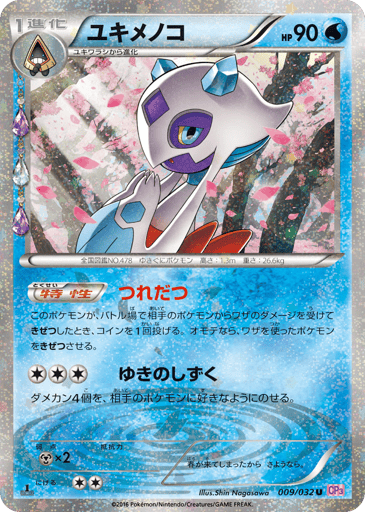
CP3 009/032・2016 ユキメノコ U :1ED
Froslass
CP3 009/032 · Uncommon (U)
Pokékyun Collection (ポケキュンコレクション)
1ED
180-day median sale price (ungraded)
¥2,500
Find this card on Collect2Day ›How to read this price
The closing card is the lowest barrier here, and it restates the whole article: it is an Uncommon, the same tier as Jirachi (¥15,000) and Altaria (¥11,000), and it costs ¥2,500 — a sixfold spread under one letter. Its ¥2,567 weighted average is almost identical to the median, on 3 sales. In an old-set market what sets the price is mostly character popularity and real demand; the rarity symbol on the card is only one factor. It also makes a fitting close: if you want one 2016 CP3 1ED in hand, this is the cheapest way in. From the ¥230,000 Flareon EX down to here is roughly the whole price spectrum of an all-1ED old set.
Three questions to ask about an old set’s prices
Frequently asked
What does 1ED mean, and why is all of CP3 1ED?
1ED is the First Edition print run, marked with its own stamp on the card face. Most lines release a 1ED and then an unmarked general print, so the same card has two versions to price against. CP3 is a concept pack: all 32 cards were released only as 1st Editions, with no later reprint, so every card in the set shares the same print condition.
How can a Common cost more than an Uncommon?
Because rarity sets how hard a card is to pull, not how many people want it. CP3 is built around cute illustration, so its buyers come for the art and the character — and character popularity is independent of rarity. Raichu here (Common, ¥14,000) above Altaria (Uncommon, ¥11,000) is that gap made visible.
Are these graded prices?
No. All ten are ungraded (raw) completed-sale medians. On a ten-year-old card condition moves the price a lot, and an ungraded median already blends copies in different condition — so treat these as the centre of a band, not as a valuation of any one specific card.
Why list cards with only 3 sales?
Because the source’s own filter is at least 3 completed sales in 180 days. Three is the minimum that can produce a median at all, but it is a very thin sample — which is why the count sits in each card’s own table here, so you can decide for yourself how much weight the figure deserves.
Is a ten-year-old set still worth starting on?
This piece does not forecast; it describes where prices are. What it can tell you is the range: the cheapest card here (Froslass, ¥2,500) and the dearest (Flareon EX, ¥230,000) are nearly a hundredfold apart, so “starting on CP3” is really two different projects — picking up the low-end Commons is nothing like completing a set that contains the Double Rare.
Find CP3 from Japanese sellers on Collect2Day
Collect2Day connects you straight to Japanese sellers, so you pay the local price and consolidate everything into one cross-border shipment.
Search CP3 cardsAll prices are Japanese-market ungraded completed-sale medians and weighted averages over the last 180 days, with one-off outliers excluded, quoted in yen. They describe sales that happened — not a trend, and not a forecast. Live prices change; check the current quote on the Collect2Day listing.