

The same card carries a gap between what it sells for in Japan and what it is listed for internationally. Across the seven cards below that gap runs from HK$54 to HK$599, which looks like a story about expensive cards — until you convert it to a percentage. Then the widest gap of all, 71.7%, belongs to the cheapest card here (HK$113). And the real dividing line between the percentages is not how popular a card is. It is how the card was distributed in the first place.
The short version
- Read the percentage, not the dollar gap. The largest gap, HK$599, sits on the dearest card; the widest percentage, 71.7%, sits on the cheapest at HK$113.
- The percentages group by distribution channel, and the groups do not overlap — deck-exclusive 58.0-71.7%, current expansion 36.2-51.1%, an older event promo 35.3%.
- This is a paper gap. The international figure is a listing price, not a sale; freight and service fees come off the top, and they bite hardest on cheap cards.
What decides how wide the gap is: the distribution channel
Start by separating the two readings. The dollar gap is an absolute number and it mostly reflects how expensive the card is — HK$599 on a HK$1,018 card, HK$54 on a HK$153 one. That on its own tells you nothing about which is the better card to buy from Japan. The percentage is the comparable measure: a HK$286 gap on a HK$399 card is 71.7%, wider than the 58.8% behind that HK$599.
Lay the seven out by percentage and the grouping is remarkably clean. The four cards from Start Deck 100 “Battle Collection” run 58.0% to 71.7%. The two from the current high class pack “MEGA Dream ex” run 36.2% to 51.1%. The 2019 S-P event promo is 35.3%. The three groups do not overlap at all: the narrowest deck-exclusive card, at 58.0%, is still wider than the widest expansion card at 51.1%.
Why would that be? The most plausible account is on the supply side. A deck-exclusive card comes out of exactly one product, in a fixed release window, with no restock — so the international market can only be fed through layers of resale. A current expansion is still being opened in bulk on both sides, which leaves middlemen little room. An event promo is the opaque case: distribution volume is never published and it trickles out over a long period, so neither market restocks in one go. Worth stating plainly: this article has sale prices and listing prices only — no print runs, no inventory — so that account is a hypothesis, not a measurement.
One last thing to be clear about, because it changes the arithmetic directly: the international number is a listing reference, a median across several variants, not a record of completed sales. Only the Japanese side is a sale. Subtracting one from the other gives a paper gap, and freight plus service fees come out of that gap — the smaller the ticket, the heavier that fixed cost weighs. How much cheaper is buying direct from Japan works that calculation through properly. All amounts are Hong Kong dollars, converted at source on the day; both sides are ungraded prices.
Seven cards, ordered by percentage gap
-
#1
MC 762/742 メガエンブオーex SAR仕様
Mega Emboar ex, special spec
MC 762/742 · SAR spec
Start Deck 100 “Battle Collection” (スタートデッキ100「バトルコレクション」)
Deck-exclusive · Japan-side sales 6 sales
Japan sale median (ungraded)
HK$419
Find this card on Collect2Day ›What this card demonstrates
The largest paper gap here: a HK$419 Japan sale median against a HK$1,018 international listing reference, HK$599 apart on one card. As a percentage that is 58.8% — the narrow end of the four deck-exclusive cards, which is exactly how a dollar gap and a percentage can give opposite answers. The SAR spec is the hardest pull in this deck product; Japanese domestic opening volume is high and second-hand stock turns over quickly, which holds the price down at home, while anything leaving Japan is marked up through successive hands. Note only six Japan-side sales sit behind that median, so treat it as a level rather than a price.
-
#2
MC 760/742 ボスの指令(カラスバ)SR仕様
Boss’s Orders (Crasher Wake), special spec
MC 760/742 · SR spec
Start Deck 100 “Battle Collection” (スタートデッキ100「バトルコレクション」)
Deck-exclusive · Japan-side sales 10 sales
Japan sale median (ungraded)
HK$345
Find this card on Collect2Day ›What this card demonstrates
The thickest sample in the article: ten Japan-side sales, the most of the four deck-exclusive cards, which makes its HK$345 median the steadiest of them rather than the product of one or two unusual trades. Against a HK$821 international listing reference the paper gap is HK$476, or 58.0% — the narrowest of the deck-exclusive group and still wider than any expansion card here. It is a practically useful Supporter, wanted by deck builders and collectors at once, and that double demand usually both supports the price and clears international stock faster.
-
#3
MC 743/742 エリカのモンジャラ AR仕様
Erika’s Tangela, special spec
MC 743/742 · AR spec
Start Deck 100 “Battle Collection” (スタートデッキ100「バトルコレクション」)
Deck-exclusive · Japan-side sales 3 sales
Japan sale median (ungraded)
HK$271
Find this card on Collect2Day ›What this card demonstrates
One thing first: only three Japan-side sales stand behind this one, so HK$271 is a level and not a price — on a thin sample a single cheap listing or one eager buyer moves the median. Against a HK$695 listing reference the paper gap is HK$424, or 61.0%. The AR spec is a full-scene illustration, and buyers at this tier mostly come for the artwork, which combined with thin supply is why the percentage looks so wide. Reading a few more weeks of sales beats deciding against a three-sale median.
-
#4
MC 748/742 マリル AR仕様
Marill, special spec
MC 748/742 · AR spec
Start Deck 100 “Battle Collection” (スタートデッキ100「バトルコレクション」)
Deck-exclusive · Japan-side sales 6 sales
Japan sale median (ungraded)
HK$113
Find this card on Collect2Day ›What this card demonstrates
The widest percentage in the article, and also the smallest ticket: a HK$113 Japan sale median against a HK$399 listing reference, HK$286 apart, 71.7% below. Those two facts arriving together is not a coincidence — freight, handling and resale costs are a much larger share of a cheap card’s price, and once it leaves Japan that cost structure is magnified into a very wide percentage. Which makes this the one card here that most needs its own arithmetic: how much of the HK$286 survives freight and service fees is the whole question of whether it is worth buying.
-
#5
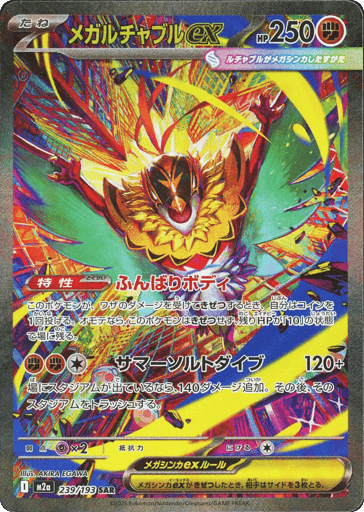
M2a 239/193・2025 メガルチャブルex SAR
The Mega Evolution of Hawlucha ex
M2a 239/193 · Special Art Rare (SAR)
High class pack “MEGA Dream ex” (MEGAドリームex)
Current expansion · Japan-side sales 7 sales
Japan sale median (ungraded)
HK$64
Find this card on Collect2Day ›What this card demonstrates
Step outside the deck product and the same logic holds on a current high class pack card, just at a much smaller scale: a HK$64 Japan sale median against a HK$131 listing reference, HK$67 apart, 51.1%. Why the narrowing? The set is still in its heavy pack-opening phase, both markets have supply, and the international side restocks about as fast as Japan does, which leaves the middle layers little room to mark up. This card is the article’s thesis in one row: the width of a gap tracks the depth of supply far more than it tracks how good the card looks.
-
#6
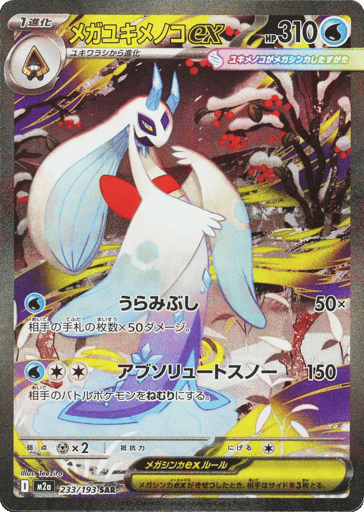
M2a 233/193・2025 メガユキメノコex SAR
Mega Froslass ex
M2a 233/193 · Special Art Rare (SAR)
High class pack “MEGA Dream ex” (MEGAドリームex)
Current expansion · Japan-side sales 3 sales
Japan sale median (ungraded)
HK$104
Find this card on Collect2Day ›What this card demonstrates
The card to be most careful with. A HK$104 Japan sale median — on three sales — against a HK$163 listing reference, HK$59 apart, 36.2%, among the narrowest here. The interesting part is that its Japan-side median sits ABOVE card 5 from the same set (HK$104 against HK$64), which need not mean it is genuinely dearer; three sales landing at the higher end would produce the same reading. A sparsely traded card is the worst case for judging value from a single median — wait for the Japanese sample to thicken, or compare it against the other SARs in its set.
-
#7
S-P 267・2019 アルセウスV プロモ
Arceus V promo
S-P 267 · Promo (PROMO)
Sword & Shield Promos
Event promo · Japan-side sales 5 sales
Japan sale median (ungraded)
HK$99
Find this card on Collect2Day ›What this card demonstrates
An older card to close on, and the narrowest percentage here: a HK$99 Japan sale median against a HK$153 listing reference, HK$54 apart, 35.3% below. It is an S-P event promo, part of no regular expansion, distributed through events and product bundles, so Japanese domestic stock has never been especially scarce and the price was never pushed down hard. Which returns to the point of the article: the buy-direct-from-Japan gap exists on deck-exclusive cards, current expansion cards and event promos alike — only its width changes, and what changes it is how the card entered the market.



Three questions to ask of any price gap
FAQ
What does “spec” (仕様) mean on these cards?
A version of a card exclusive to one specific product. The first four here come from Start Deck 100 “Battle Collection”, carry MC set codes, and their artwork and finish appear in no ordinary booster pack — which is part of why their percentage gaps are the widest.
Why is this article in Hong Kong dollars when others use yen?
Because of what is being compared. Putting a Japanese sale price beside an international listing price means two currencies, so the source data converts both to HKD at the day’s rate before comparison. Articles that only use one-sided Japanese market prices stay in yen with no conversion. The method is currency-agnostic; every conversion adds an error layer.
How much of the gap do freight and service fees consume?
This data cannot answer that — it has both sides’ prices and no shipping quote for any of the seven. What is certain is the direction: fixed costs weigh most on cheap cards, so the widest-percentage, smallest-ticket combination on card 4 is exactly the one that needs freight and fees added back before judging it.
Is a median from three sales usable?
As a rough level, yes; as a price, no. Cards 3 and 6 are both in that position, and card 6 even reads dearer on the Japanese side than card 5 from the same set — which is most likely three sales landing high rather than a genuinely more valuable card.
Will the gap persist?
No forecast here. What can be said is that the gap comes from a difference in supply and turnover speed between the two markets, so as long as Japanese second-hand stock moves faster than the international side, the basis for it remains — while the actual numbers will move with pack-opening volume, exchange rates and campaigns. The method (percentage first, then channel, then subtract the fees) outlasts any week’s figures.
Buy direct from Japan with Collect2Day
Collect2Day buys direct from the Japanese market, so you pay Japanese prices and ship everything home in one consolidated parcel.
Start searchingThe Japanese figures are completed-sale medians and the international figures are listing references; they are different kinds of data, and subtracting them gives a paper gap before freight and service fees. Amounts are Hong Kong dollars, converted at source on the day, for comparison only. Live pricing moves; the figure on the Collect2Day page is the one that applies.