

XY-P is the Japanese promo line of the XY era — cards that were never in a booster pack, handed out instead at events, by lottery, or as a bonus for buying something. The line has no release schedule, so what a card is worth is usually decided not by a rarity symbol but by how widely it was distributed at the time. These ten cards are ranked by their 180-day median sale price, and they show what that looks like in the data.
The short version
- The distribution channel sets the circulation. Lottery and event-only cards see three or four sales in six months; a purchase bonus sees 15; a movie album bonus sees 69. That is where the price gap comes from.
- A median built on three sales is not a market price. It is “the range someone was willing to trade at recently” — not the same class of evidence as a level held up by 69 sales.
- Read the median and the mean together. Close together means the trades clustered; far apart means condition and completeness were driving the asking price.
What XY-P is: not a card you pull from a pack
The P is for Promo. None of these cards was ever in a pack’s pull rate; the only way to get one was for the Japanese side to hand it out — at a large event, by lottery, as a bonus for buying a designated product, or bundled with a commemorative set. Once the distribution ended it ended, and nothing has been printed into circulation since, so supply only concentrates further in collectors’ hands.
The consequence is that XY-P has no rarity ladder you can reason from. Within one line, a card can sit in six figures for years because it was only handed out at a handful of occasions, while another sits steadily in five figures because it came bundled with a widely sold set — and the two can carry identical card-type markings. To understand the price you have to look at how it was distributed.
Why the distribution route shows up in the sale count
How open the channel was ends up as a number you can measure: how many times the card surfaced in half a year. Three of the ten below make this plain. At number 9, Mega Gengar EX was a gift to buyers of designated products in the White Mega Gengar campaign — spend and you got one, so more of them reached the market than a lottery card, and it records 15 sales over the last 180 days. At number 10, Hoopa was the bonus in a movie commemorative album set, distributed in volume with that set, and it shows 69 sales — the most of any card here.
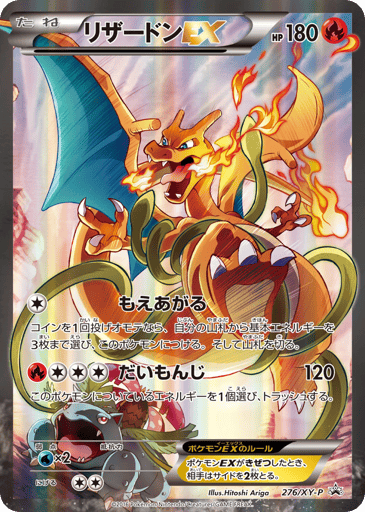
At the other end is number 1, the Charizard EX Art Collection: a narrow channel and a small print, 7 sales over 180 days, median ¥800,000. Those 7 sales do not mean it is unpopular — they mean the entire market saw it seven times in six months. Circulation depth is part of the price. Within one line, the distance between ¥800,000 and ¥85,000 is largely the distance between a narrow hand-out and a bundled set.
Before reading the ten prices: look at the sale count
Every card below carries three figures: the 180-day median sale price, the mean sale price over the same window, and the sale count. You need all three to know how solid the level is. On a card with three sales, the median is properly read as “the range someone was willing to trade at in the last six months”, not a price to negotiate against; on a card with 21 or 69, the median starts to mean a market rate in the ordinary sense.
The relationship between median and mean carries information too. Close together, and those few trades clustered. A mean well above the median means some trades in the window sat above it, so the band is not narrow. A mean below the median means low trades were not unusual. On promos, that gap usually comes from condition and whether the accompanying items are complete — not from any change in how popular the character is.
Ten XY-P cards by 180-day median sale price
-
#1
276/XY-P・2013 リザードンEX: プロモ(アートコレクション)[XY-P 276/XY-P](プロモーションカード「XY-P」)
Charizard EX (Art Collection)
#276/XY-P · Promo
XY Promos · 2013
180-day median (ungraded)
¥800,000
Find this card on Collect2Day ›How this card was distributed
This is the ceiling of the whole XY-P line. The name Art Collection states its position: not a competitive card but a collector-facing promo sold on its illustration, with a narrow channel and a small distribution. Charizard is also one of the most durably supported characters in the Japanese market, and the two together keep this in the “ask the price whenever you see one” category. In the data: 180-day median ¥800,000 on just 7 sales. Those 7 are worth dwelling on — not a frenzy, but the circulation depth of a card that surfaces a handful of times in half a year. The median ¥800,000 and the mean ¥814,286 sitting this close also show those few trades clustered tightly rather than one or two extremes pulling the figure up.
-
#2
050/XY-P・2013 日本代表のピカチュウ: プロモ[XY-P 050/XY-P](プロモーションカード「XY-P」)
Japan National Team Pikachu
#050/XY-P · Promo
XY Promos · 2013
No front-face art available; the image is a generic card back
180-day median (ungraded)
¥490,000
Find this card on Collect2Day ›How this card was distributed
This is the card that first made people realise a Pikachu promo could be expensive. It is a themed campaign card rather than pack product; the number handed out and who could get one were both limited, so little of it ever reached the secondary market. Unlike the purely collector-facing Art Collection at number 1, this one belongs to the “Pikachu in costume” thread — Pikachu dressed for a theme, a line that went on to produce several variants within XY-P, and this is its early representative. 180-day median ¥490,000 on 8 sales; the mean of ¥520,292 sits somewhat above the median, meaning some trades in the window landed higher and the band is not especially narrow. Collectors chasing the Pikachu thread usually start counting here.
-
#3
203/XY-P・2013 ポンチョを着たピカチュウ: プロモ (ポンチョピカチュウ) [XY-P 203/XY-P](プロモーションカード「XY-P」)
Poncho-wearing Pikachu
#203/XY-P · Promo
XY Promos · 2013
180-day median (ungraded)
¥230,000
Find this card on Collect2Day ›How this card was distributed
This one takes a different route: not the pull of the character, but the campaign idea of dressing it up. Pikachu in a poncho, paired with other Pokémon designs, is instantly recognisable — one of the most identifiable designs of the XY era, and the reason these cards are treated in Japan as display pieces more than playing cards. The hard part with this type is circulation: only 4 sales in the last 180 days, median ¥230,000, with a mean of ¥247,000 above it — so those four trades already sat noticeably apart, and condition and completeness both moved the asking price. On a sample that thin the median should not be read as a firm market rate, but as the range someone was willing to trade at recently. That is common across all of XY-P.
-
#4
098/XY-P・2013 メガトウキョーのピカチュウ: プロモ[XY-P 098/XY-P](プロモーションカード「XY-P」)
Mega Tokyo Pikachu
#098/XY-P · Promo
XY Promos · 2013
180-day median (ungraded)
¥200,000
Find this card on Collect2Day ›How this card was distributed
Of the top four cards here, this is the only one with a double-digit sale count: 21 sales in 180 days, median ¥200,000, mean ¥201,630 — a gap small enough to ignore. In a line where samples are usually a handful, 21 counts as a real market, and it means buyers and sellers broadly agree on where this card sits. The card itself is a region-themed limited hand-out pairing Pikachu with a city theme, and it is many collectors’ first expensive XY-P card. For someone starting on XY-P it is arguably the most useful reference here — not because it is the priciest, but because its price is the one you can actually check against something.
-
#5
232/XY-P・2013 レックウザ: プロモ[XY-P 232/XY-P](プロモーションカード「XY-P」)
Rayquaza
#232/XY-P · Promo
XY Promos · 2013
180-day median (ungraded)
¥167,000
Find this card on Collect2Day ›How this card was distributed
A reminder that XY-P is not all Pikachu. Rayquaza has long been one of the most commercially powerful legendaries in the Japanese market, and it had heavy exposure during the XY era, so demand for this promo comes from character collectors as well as people completing the line. 180-day median ¥167,000 on 3 sales, with a mean of ¥159,000 below the median — on three trades, a single low sale is enough to drag the average down, so the two figures have to be read together and neither quoted alone. This combination, strong character pull on an extremely thin sample, is the typical state of a mid-table XY-P card: no shortage of buyers, a shortage of sellers.
-
#6
235/XY-P・2013 ジラーチ: プロモ[XY-P 235/XY-P](プロモーションカード「XY-P」)
Jirachi
#235/XY-P · Promo
XY Promos · 2013
180-day median (ungraded)
¥165,000
Find this card on Collect2Day ›How this card was distributed
This card represents another thread running through XY-P: the tie between mythical Pokémon and the sense of a limited hand-out. Mythicals conventionally arrive through events in both the games and the card game, and on the secondary market that converts straight into collector demand. 180-day median ¥165,000 on 3 sales, mean ¥161,666 — the two sit very close, so all three trades happened at a similar level. A sample of three does not indicate a card nobody wants; it indicates holders who will not sell. Much of XY-P sits in long-term collections and may not change hands in a year. Against the Rayquaza above it (232/XY-P) the two levels are quite close, which shows how far distribution background counts for as much as character popularity inside this line.
-
#7
001/XY-P・2013 ピカチュウ: プロモ[XY-P 001/XY-P](プロモーションカード「XY-P」)
Pikachu
#001/XY-P · Promo
XY Promos · 2013
180-day median (ungraded)
¥150,000
Find this card on Collect2Day ›How this card was distributed
This is where the numbering starts. The number 001 is itself a reason to own it — as the first XY-P card, the symbolism matters as much as what is printed on it, and collectors completing the line often deliberately begin here. 180-day median ¥150,000 on 6 sales, with a mean of ¥160,833 above the median, so the high and low of the window sat some distance apart. The most characteristic promo situation — the same card, one notch of condition apart, a very different asking price — is clearly visible on this one. With no EX and no special card type behind it, it holds six figures purely on being first in the line, which is in a sense the whole collecting logic of XY-P: the release background is what prices the card.
-
#8
100/XY-P・2013 レックウザ イラストコレクション: プロモ[XY-P 100/XY-P](プロモーションカード「XY-P」)
Rayquaza (Illustration Collection)
#100/XY-P · Promo
XY Promos · 2013
180-day median (ungraded)
¥118,000
Find this card on Collect2Day ›How this card was distributed
This one pairs neatly with the Rayquaza above it (232/XY-P): the same Pokémon, two card positions, two different levels. The Illustration Collection thread follows the same thinking as the Charizard EX at number 1 — sold on the illustration and the presentation rather than on competitive performance. 180-day median ¥118,000 on 3 sales, mean ¥107,667 below the median. A price gap within one character usually comes down to the scale of the distribution, the card’s position and its condition, rather than any change in the character’s popularity. As a way to understand how XY-P is priced, this pair is the best teaching example in the list.
-
#9
079/XY-P・2013 MゲンガーEX P [XY-P 079](プロモーションカード「白いメガゲンガーキャンペーン 対象商品購入者プレゼント」)
Mega Gengar EX
#079/XY-P · Promo
XY Promos · 2013
180-day median (ungraded)
¥97,000
Find this card on Collect2Day ›How this card was distributed
The distribution here is worth spelling out: this was a gift to buyers of designated products in the White Mega Gengar campaign — you had to buy something specific to get one. A purchase-bonus route behaves quite differently from a lottery or a region-limited hand-out: anyone willing to spend could obtain it, so more of them reached the market than a lottery card ever would. The data agrees: 15 sales in 180 days, which is fairly active for XY-P, median ¥97,000 and mean ¥93,046 — the mean slightly under the median, so low trades are not rare. It is also a product of the period when Mega Evolution was the biggest topic in the game, and Gengar’s standing among ghost-type characters has been stable for years. For someone entering XY-P without starting at the very top, this is a common way in.
-
#10
155/XY-P・2013 フーパ P (開封済) [XY-P 155](プロモーションカード「フーパのおでまし~!アルバムセット 映画公開記念」)
Hoopa (opened)
#155/XY-P · Promo
XY Promos · 2013
180-day median (ungraded)
¥85,000
Find this card on Collect2Day ›How this card was distributed
This is the most frequently traded card in the whole set of data: 69 sales in 180 days, median ¥85,000, mean ¥84,046 — the two figures almost overlap. It was the bonus in a movie commemorative album set, and a set distribution means a large number left the shelves at the time; the data also marks it as opened condition, and the divide between sealed and opened is unusually pronounced on this kind of product. The value of those 69 sales is that they give the whole XY-P line a reference point it otherwise lacks — most of these cards trade three or four times in six months, which makes “market price” hard to define, and this one does not have that problem. Use it as the ruler, then look back at the ¥800,000 Charizard EX, and where the spread inside XY-P comes from is much clearer.


Three things the numbers do not mean
FAQ
Which era does XY-P belong to?
The XY era; the line began releasing in August 2013. It is a closed promo line — no new cards will be added — so supply only concentrates further in collectors’ hands over time.
Is a price built on three sales worth anything?
Yes, but it needs a different reading. Three sales tell you the card surfaced three times in six months and traded in this range: a range, not a price. In that situation the gap between median and mean is more informative than the median itself — close together means those trades clustered, far apart means condition and completeness were doing a lot of the work.
How much difference does opened versus sealed make?
On set bonuses like these, a great deal. Card 10 here, Hoopa, is explicitly recorded in opened condition, so ¥85,000 is a price for an opened copy. Sealed examples of the same product are a separate market and cannot be compared directly.
How does a collector outside Japan buy these?
XY-P supply is concentrated in the Japanese market, and the figures in this piece are Japanese sellers trading with Japanese buyers, with no cross-border shipping or handling included. Collect2Day’s direct-from-Japan route exists for exactly this: read the Japanese trading level first, then decide.
Find XY-P stock on Collect2Day
Distribution background first, sale count second, price third. All ten cards above are searchable on Collect2Day.
Search XY-P promo cardsPrices are actual Japanese-market trade data over a 180-day window, for reference only. This piece reviews card types and current levels; it does not discuss price direction and is not investment advice.