
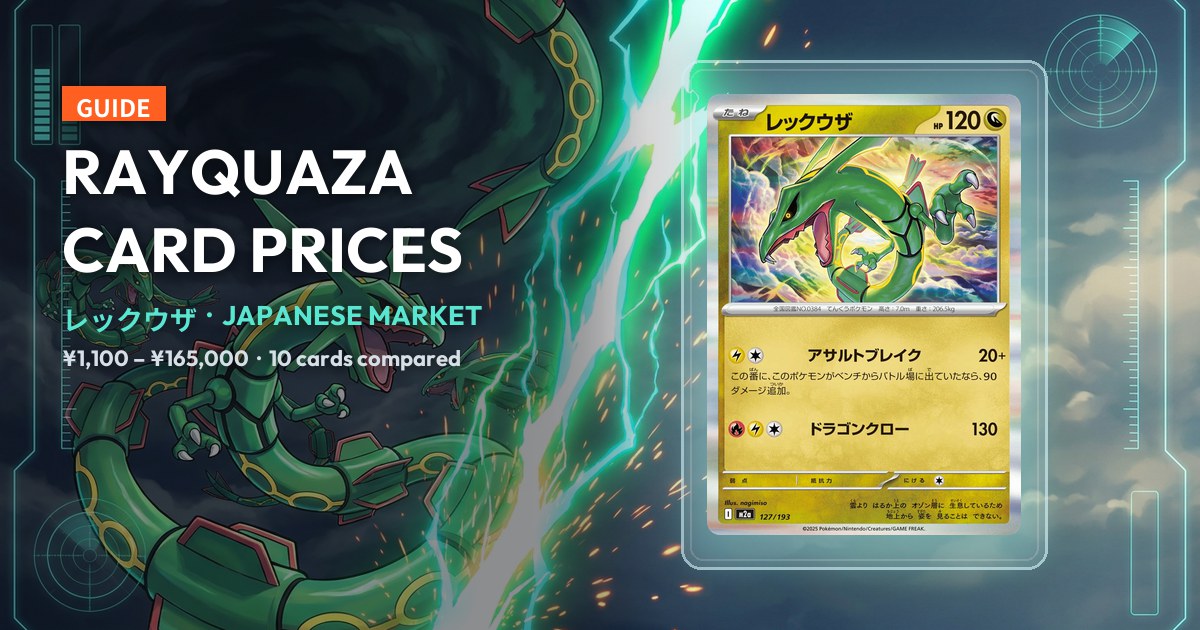
Search for a Rayquaza card and the first thing you see is a five-figure price tag. The top of the Japanese market — Rayquaza V SR SA — sits at a ¥165,000 ungraded median, and those are the cards that circulate on social media. They are not the whole picture. The same Pokémon has four cards under ¥3,000 on the Japanese market right now, spanning 2018 to 2025 and three different card types.
The short version
- Entry point is around ¥1,100 — the Poké Ball mirror Rayquaza, M2A 127/193, is the cheapest special-treatment printing on this list.
- Four cards sit under ¥3,000, covering GX, VMAX and mirror treatments, from 2018 through to 2025.
- The gap between entry and top is about 150× — S7R 076/067 (Rayquaza V SR SA) leads at ¥165,000.
Four Rayquaza cards under ¥3,000
Listed cheapest first. What they share is that none is an ordinary pack pull — each has some form of special treatment — and all four still land in four figures.
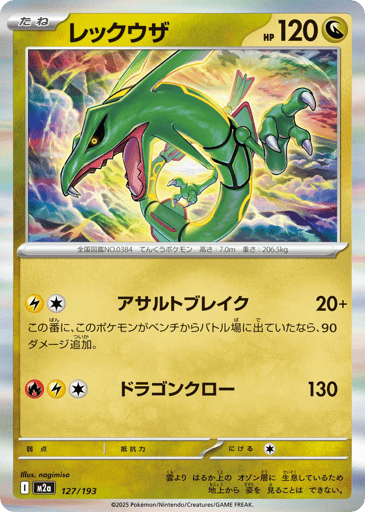
1. Rayquaza, Poké Ball mirror — M2A 127/193 — ¥1,100
The newest card here and the cheapest. M2A is a 2025 High Class Pack, and this printing uses the Poké Ball pattern mirror foil (オシャボミラー) rather than a full-art SR treatment. That is why it reads instantly as a special version while staying at the bottom of the four-figure range. If the goal is simply to own a Rayquaza that visibly is not a base card, this is the lowest bar on the list.
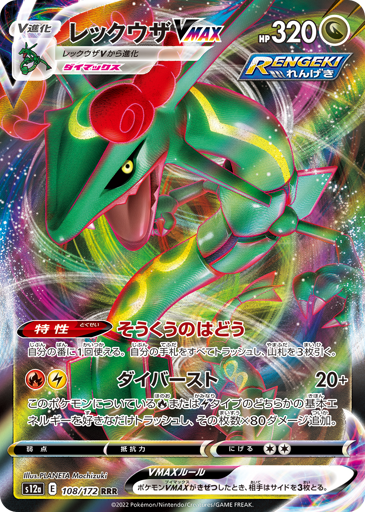
2. Rayquaza VMAX RRR — S12A 108/172 — ¥1,500
VSTAR Universe was the 2022 year-end compilation set — broad in scope and printed heavily, so cards at this tier circulate in volume. RRR (triple rare) is the standard rarity for a VMAX: a dynamic frame rather than a full-art border. At ¥1,500 this tends to be where a collector’s first VMAX lands.
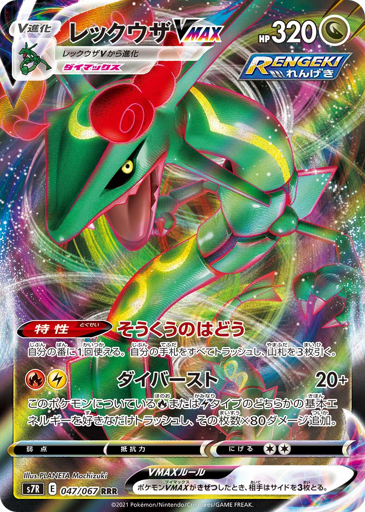
3. Rayquaza VMAX RRR — S7R 047/067 — ¥2,000
Same card type and same rarity as the one above, yet roughly a third more expensive. The variable is the set. Blue Sky Stream is a Rayquaza-led expansion — it is also where the ¥165,000 card at the top of this page comes from. That shared set identity is the background to both prices. If you intend to collect by set rather than by card, this is the accessible way in.
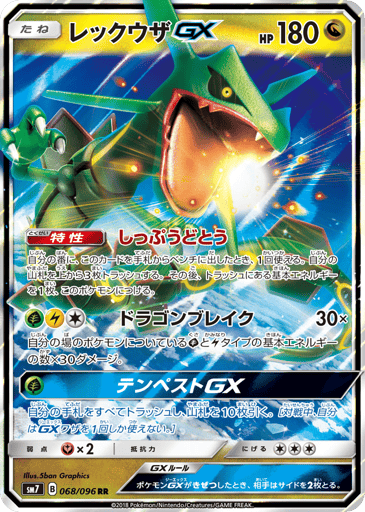
4. Rayquaza GX RR — SM7 068/096 — ¥3,000
The ceiling of the entry tier, and the oldest of the four. SM7 belongs to the Sun & Moon era; GX was that era’s signature mechanic and has long since rotated out, so this is a collector’s card rather than a playable one. RR (double rare) was a common rarity at the time — yet it still costs more than two newer VMAX cards. Age is the only variable on this list that accounts for that.
The five-figure tier: the market’s top six
Ranked by ungraded median, highest first. Read alongside the entry tier, this is where you can see what actually separates a ¥1,100 Rayquaza from a ¥165,000 one — not the Pokémon, but the card type, the rarity and how the card was distributed.
-
1
Rayquaza V SR: SA ¥165,000 S7R 076/067 · 2021 · Expansion “Blue Sky Stream” · Find this card ›
-
2
Rayquaza GX SSR ¥139,999 SM8B 240/150 · 2018 · High Class Pack “GX Ultra Shiny” · Find this card ›
-
3
Rayquaza P (promo) ¥60,000 BW-P 144/BW-P · 2010 · “Pokémon + Nobunaga’s Ambition” first-run bonus · Find this card ›
-
4
Rayquaza EX P (promo) ¥60,000 XY-P 122/XY-P · 2013 · Emerald Break Pokémon Card Chance Campaign · Find this card ›
-
5
Rayquaza VMAX CSR ¥29,800 S8B 252/184 · 2021 · High Class Pack “VMAX Climax” · Find this card ›
-
6
 M Rayquaza EX (promo)
¥26,780
S8A_P 024/025 · 2021 · Promo Card Pack 25th ANNIVERSARY edition · Find this card ›
Third and fourth place are worth pausing on: both are promos (P), which never appeared in a retail pack at all. They were distributed through a first-run bonus and a campaign, and at 2010 and 2013 they are the two oldest cards on this list. By contrast fifth and sixth, both from 2021, have settled back into the ¥20,000s.
How to read the rarity codes
Japanese Pokémon cards print their rarity as a short code in the bottom-right corner. These codes explain most of the price spread on this page — they are more useful to learn than any individual card name.
Three things to check before you buy
Match the card number, not the name
One Pokémon can have dozens of printings across sets and rarities — this page alone lists three cards called “Rayquaza VMAX”. The thing that identifies exactly one card is the set code plus its number, like S7R 047/067. Search, compare and order against that code and you will not end up with the right name and the wrong printing.
Know whether a price is graded or ungraded
Every figure here is an ungraded (raw) median — the card itself, not slabbed by PSA, BGS or any other grader. Graded cards trade in a separate market where the price depends on the assigned score, and the two are not directly comparable. When you see a listing, establish which side of that line it is on before you compare anything.
Set can matter more than rarity
Cards two and three are the cleanest demonstration on this page: identical card type, identical rarity, roughly a third apart in price, and the only difference is which expansion they came from. When a set is built around a particular Pokémon, the related cards in it tend to price higher across the board. Weigh the set alongside the rarity.
Frequently asked questions
What is the cheapest special Rayquaza card?
On this list, M2A 127/193 — the Poké Ball mirror printing from the 2025 MEGA Dream ex High Class Pack, at roughly a ¥1,100 ungraded median. It is the only special-treatment card here under ¥1,500.
Are SR and SA the same thing?
No. SR (スーパーレア) is a rarity tier; SA (スペシャルアート) describes the illustration. A card can be both, written “SR: SA” — which is what S7R 076/067 is, and part of why it tops this list.
Why do two Rayquaza VMAX RRR cards differ by a third in price?
Because they are from different sets. S12A came from the broad 2022 compilation set; S7R is the Rayquaza-led expansion. With card type and rarity held constant, the set is the only variable between them.
Why are the promo cards so expensive?
Because they were never in packs. Promos were handed out through specific events, first-run purchase bonuses or collaboration campaigns, so the number in circulation is on a different scale from a pack-pulled card. The two oldest cards here, from 2010 and 2013, are both promos.
Can I buy Japanese Rayquaza cards from outside Japan?
Yes — that is what Collect2Day does. Prices on this page are Japanese-market medians, which is the market these Japanese-language printings actually trade in; buying locally outside Japan usually means paying an importer’s markup on top.
Search for these cards on Collect2Day
Collect2Day buys directly from the Japanese market at local prices and consolidates everything into a single cross-border shipment.
Start searchingPrices shown are reference median ungraded sale prices from the Japanese market, given for comparison only. Actual prices move with the market — check the live figure on the Collect2Day page.