
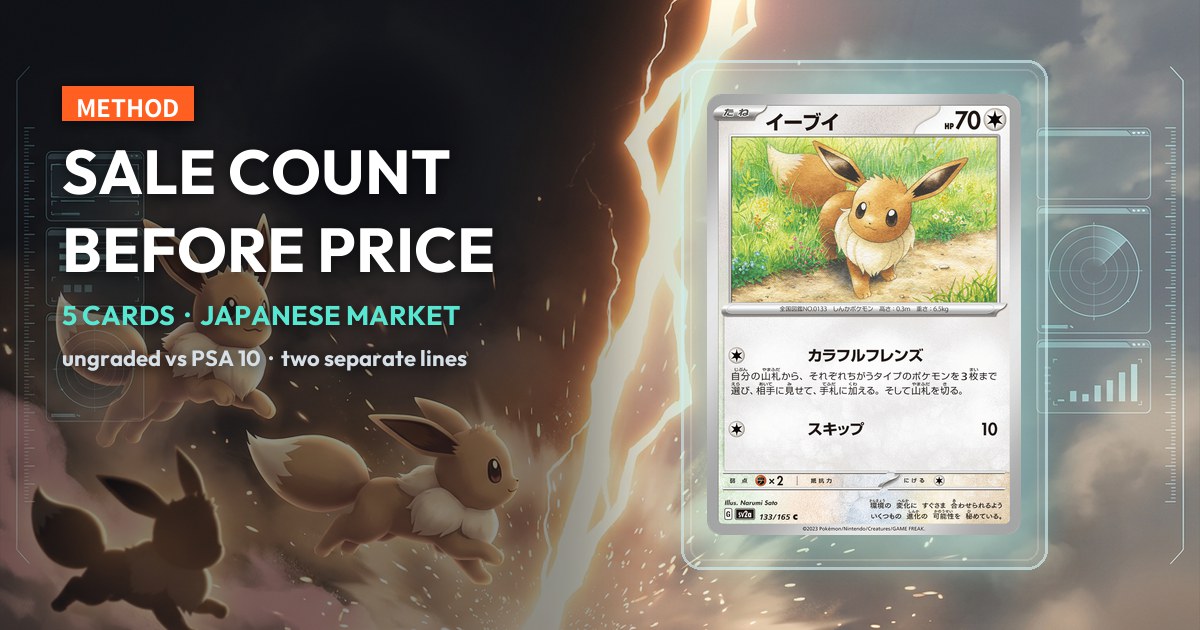
The hard part about a dormant card is not that the price fell — it is that nobody is trading it at all. To work out whether buyers have come back, the first number to read is not the price but the sale count. These five Japanese-market cards show the method: three where the sale count has started rebuilding, plus two comparisons — an older generation card and a high-value promo — to show what the same reading looks like at a different price level.
The short version
- Sale count first, price second. A −20.9% built on one sale and a flat 0% built on twenty-five are not the same class of evidence.
- Ungraded and PSA 10 are two different goods. The gap between them is not an appreciation figure, and it is not the high and low of one pool.
- A missing week-on-week figure is itself information. It means there were not enough sales to compute a trend from.
Why the sale count comes before the price
A card can go through a quiet stretch with no sales at all while the price field still shows a number. That number is the last trade — a historical record, not a current market price. Only once the sale count starts rebuilding does the price begin to mean “what someone will pay now”. This piece treats a quiet stretch as averaging two sales a week or fewer between 90 and 30 days back, and a return as ten or more sales in the last thirty days; all five cards were picked on that line.
Thin samples move on single trades. Across these five cards the ungraded tier carries between one and eight sales; over the same period the PSA 10 tier reaches twenty-five. The two tiers of one card can therefore differ enormously in how much their prices can be trusted — and no table says so on the reader’s behalf. It is in the sale-count column.
Ungraded and PSA 10 are two lines, and you cannot subtract one from the other
Ungraded (raw) is the card as it comes. PSA 10 is a card that has been submitted and came back with a perfect grade. The gap between them contains the grading fee, the weeks the card spends away, and the risk that it grades below 10 — so “PSA 10 minus ungraded” is not a spread anyone can simply collect.
Nor does a disagreement in direction mean the market turned. On SM-P 270 the ungraded line is +5.3% week on week while PSA 10 is −3.2% over the same week — the first from two sales, the second from thirteen. Each line reports trades in its own pool. They are not two quotes for the same goods.
Five cards: the sale count and both tiers
-
#1
133/165・2023 イーブイ C: モンスターボールミラー[SV2a 133/165](強化拡張パック「ポケモンカード151」)
Eevee
#133/165 · Poké Ball Mirror (Common)
Pokémon Card 151 (JP enhanced expansion)
Anchor card
30-day median (ungraded)
¥6,999
Weekly VWAP, ungraded (second row is that week’s sale count)
Find this card on Collect2Day ›What this card demonstrates
Pokémon Card 151 is a first-generation callback set, and Eevee is not among its rarest cards — but the Poké Ball Mirror pattern appears at a low rate, and Eevee carries a collector base that buys to complete a set regardless of the market. Stock released recently has cleared quickly. There have been 10 sales over the last 30 days, so this is more than one or two isolated trades. Read the price in two tiers: ungraded median ¥6,999 and VWAP ¥6,888 on just 3 sales, −5.1% week on week; PSA 10 median ¥22,000 and VWAP ¥22,600 on 6 sales. Both samples are thin — the level is still being held up by a handful of trades, which is why the sale count is the more reliable read.
-
#2
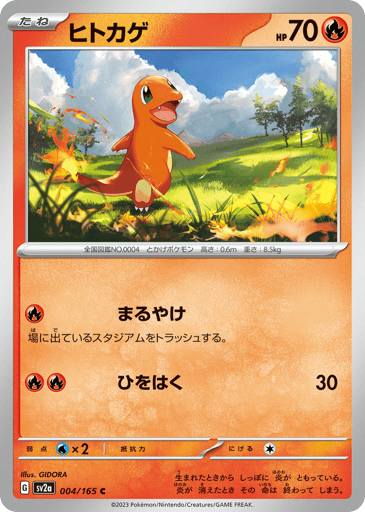
004/165・2023 ヒトカゲ C: マスターボールミラー[SV2a 004/165](強化拡張パック「ポケモンカード151」)
Charmander
#004/165 · Master Ball Mirror (Common)
Pokémon Card 151 (JP enhanced expansion)
Anchor card
30-day median (ungraded)
¥7,777
Weekly VWAP, ungraded (second row is that week’s sale count)
Find this card on Collect2Day ›What this card demonstrates
Charmander sits in an unusual spot in this set: only a small number of cards carry the Master Ball Mirror pattern, and the first of the original three starters has always been among the fastest to move. There have been 11 sales over 30 days, the middle of the three anchors. The price data needs care, though: ungraded median ¥7,777 and VWAP also ¥7,777 — PLACEHOLDER A fall computed from one trade is not a market breaking down. The PSA 10 line, median ¥22,500 and VWAP ¥22,260 on 5 sales, is steadier, but it is a post-grading price and cannot be subtracted from a one-sale ungraded figure to yield a spread. This shape — graded tier with a sample, ungraded tier with one trade — is exactly what a dormant card looks like when trading first resumes.
-
#3
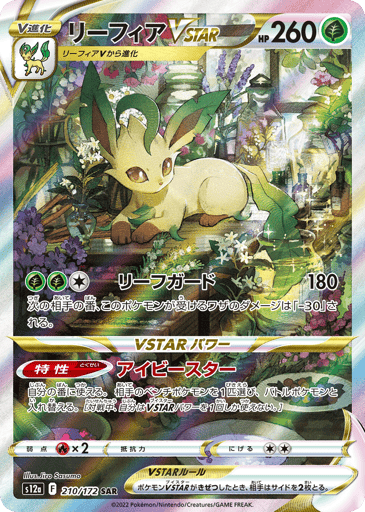
210/172・2022 リーフィアVSTAR SAR[s12a 210/172](ハイクラスパック「VSTARユニバース」)
Leafeon VSTAR
#210/172 · Special Art Rare (SAR)
VSTAR Universe (JP high class pack)
Anchor card
30-day median (ungraded)
¥6,000
Weekly VWAP, ungraded (second row is that week’s sale count)
Find this card on Collect2Day ›What this card demonstrates
Leafeon VSTAR is the most actively traded of the three anchors, at 18 sales over 30 days. It comes from VSTAR Universe, a high class pack of curated reprints, and the full-art SAR treatment plus Leafeon’s standing within the Eevee family keeps baseline demand alive with no new catalyst. It is also the cleanest card here statistically: PSA 10 median ¥15,900, VWAP ¥16,083, 25 sales, +0.0% week on week — flat. The ungraded line reads ¥6,000 for both median and VWAP, but on 1 sale, at +12.4%; that rise is far too thin to call a trend. The number worth remembering is the 25 PSA 10 sales, which show real depth behind the graded version rather than one or two trades holding it up. The ungraded side needs more sales before it can be read at all.
-
#4
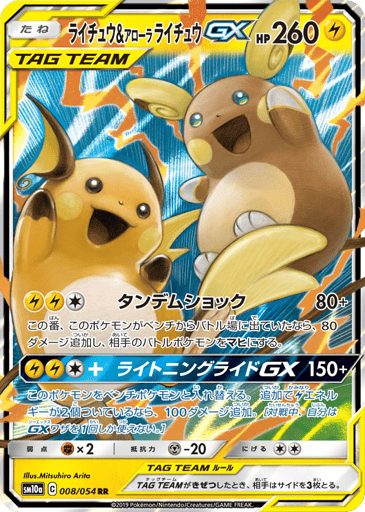
008/054・2019 ライチュウ&アローラライチュウGX RR [SM10a 008/054](強化拡張パック「ジージーエンド」)
Raichu & Alolan Raichu GX
#008/054 · Double Rare (RR)
GG End (JP enhanced expansion)
Comparison: older generation
30-day median (ungraded)
¥7,000
No PSA 10 quote for this card
Weekly VWAP, ungraded (second row is that week’s sale count)
Find this card on Collect2Day ›What this card demonstrates
The first comparison card, from GG End — a set released as the Sun & Moon era closed, when far fewer people were opening product, so today’s supply comes almost entirely from the secondary market. This is a two-character RR carrying both the original and the Alolan Raichu on one card: a crossover collectible rather than something competitive play supports. There have been 10 sales over 30 days. Its price shape differs from the three above — there is only an ungraded line: median ¥7,000, VWAP ¥7,051, 8 sales, no PSA 10 quote and no week-on-week figure recorded. That absence is informative in itself: until recently there were not enough sales to compute a trend from, and the sale count returning is the most basic signal that a dormant card is being asked about again.
-
#5
270/SM-P・2016 レッドのピカチュウ: プロモ[SM-P 270](プロモーションカード「SM-P」)
Red’s Pikachu
#270/SM-P · Promo
Sun & Moon Promos (JP)
Comparison: high-value tier
30-day median (ungraded)
¥135,000
Weekly VWAP, ungraded (second row is that week’s sale count)
Find this card on Collect2Day ›What this card demonstrates
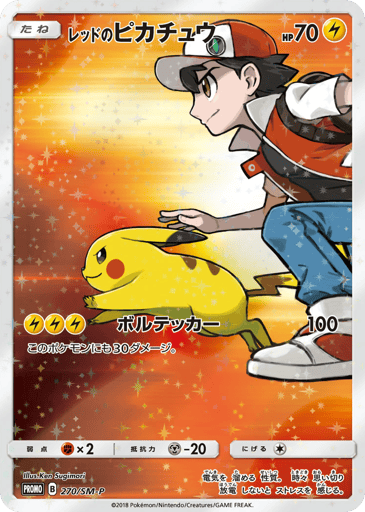
Red’s Pikachu has no official Chinese card name yet, so the Chinese editions of this piece keep the Japanese name plus the card number. It is the most expensive card here, placed last as the high-value comparison — it has in fact been trading throughout and is not a dormant-card return, which is the point: it shows what the same reading looks like further up the price scale. The defining difference between a promo and a pack-pulled card is that a promo will never be printed into circulation again, so supply only concentrates, and even in a quiet stretch trading does not fall to zero: 12 sales over 30 days. Both tiers carry samples — ungraded median ¥135,000, VWAP ¥136,500, 2 sales, +5.3% week on week; PSA 10 median ¥217,000, VWAP ¥215,514, 13 sales, −3.2%. These are two kinds of goods: the directions disagreeing does not mean one pool reversed, and the two-sale line moves on a single trade while the thirteen-sale line is the more realistic trading range.

Three things the numbers do not mean
FAQ
Can I use a price built on a single sale?
As a reference point, yes; as a market price, no. One sale tells you that one buyer and one seller met at that level. A different buyer, or a card in different condition, can land somewhere quite else. The sale count sits beside every price in this piece so that you can decide how much weight it earns.
Is a card without a PSA 10 quote a worse card?
No. A missing quote usually means too few copies have been submitted for grading to produce graded sales in the window — it says nothing about the card. SM10a 008/054 here is that case: ungraded only, on 8 sales, which is the thickest ungraded sample of the five.
Can these Japanese-market prices be treated as a Hong Kong buying price?
Not directly, but they are the right starting point for comparison. A Japanese-market figure reflects a Japanese seller trading with a Japanese buyer, with no cross-border shipping or handling in it. Collect2Day’s direct-from-Japan route exists to make that comparison usable: read the Japanese trading level first, then decide.
Put the method to work
Sale count first, then the price level, then the decision. All five cards above are searchable on Collect2Day.
Search Pokémon cards on Collect2DayPrices are actual Japanese-market trade data, for reference only. This piece reports sale counts and current levels per tier; it does not forecast prices and is not investment advice.