
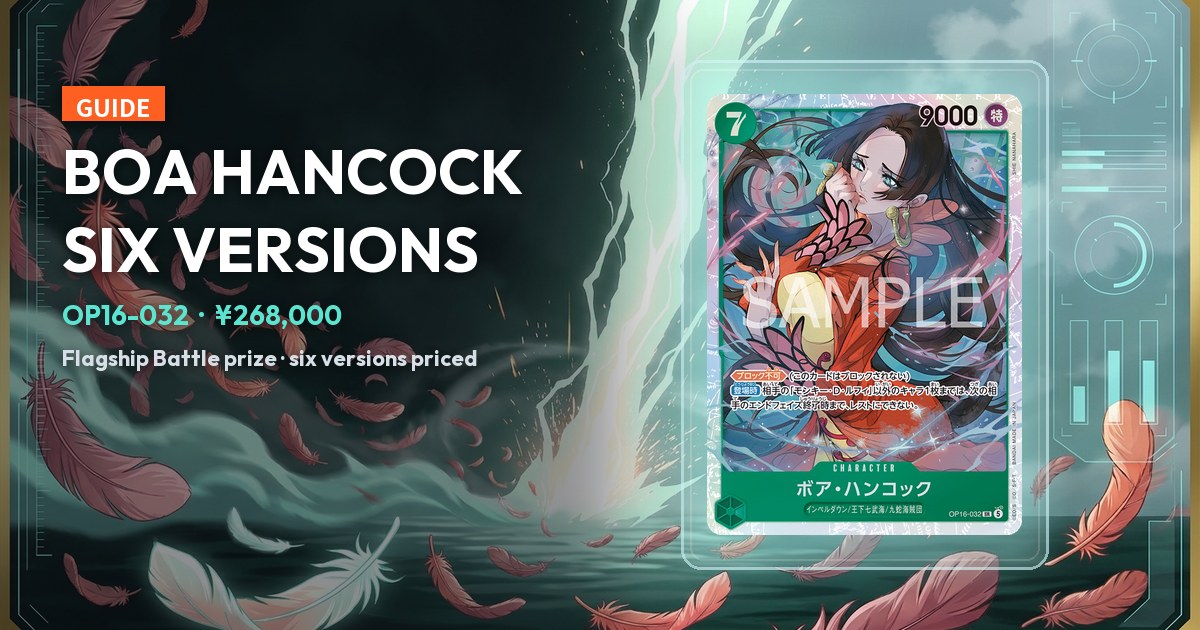
The same Boa Hancock exists in six versions with enough recent Japanese-market trades to price: ¥268,000 at the top, ¥3,300 at the bottom. Line them up highest to lowest and something that holds across the whole One Piece card market becomes visible — the rarity letter on the card does not set the order. What does is how each card was released in the first place.
The short version
- The letter does not set the price: OP16-032 and ST17-004 are both marked SR, at ¥268,000 and ¥14,800. OP13-051 is only an R and still prices above OP14-112. Read the release route, not the letter.
- One route still has tiers inside it: P-066 and P-115 are both magazine appendices, at ¥9,200 and ¥3,300. What separates them is the issue and how long the card has been out.
- There is a ceiling on how much these figures can bear: the inclusion threshold is only three ungraded sales in 90 days, and no per-card count is published — the dearest card here may rest on a handful of trades. Check how many copies are actually listed before ordering.
One character, six versions — why so far apart?
First, what these six are. They are not every Hancock card. They are the ones with at least three ungraded sales in the last 90 days, which is what it takes to quote a reference price at all. For older and promotional cards the norm is that most numbers cannot muster three sales in months — and with no sales there is no sale price, only an asking price. That is worth holding onto before reading any card-price table.
Lined up highest to lowest, the rarity ordering breaks immediately. The most expensive, OP16-032, is marked SR at ¥268,000. So is ST17-004 at rank 4 — same letter, ¥14,800. Clearer still is OP13-051 in second place: it is only an R, and it prices above both the ¥43,000 at rank 3 and the ¥14,800 at rank 4. Judge by the letter and you get this one exactly backwards.
What actually orders them is how each card was distributed — that is, how many people could get one. OP16-032 was the prize for placing at the July 2026 Flagship Battle, so only winners hold it. OP13-051 came in Judge Promotion Pack Vol.3, distributed among accredited judges and never sold at retail. OP14-112 is the wa-pattern special art from a booster set — openly sold, anyone can pull it, the pull rate is just low. ST17-004 came with the ONE PIECE CARD THE BEST storage box set: buy the box, get the card. The last two are magazine appendices, bound into Saikyo Jump and V Jump, so how many circulate depends on the magazine’s print run. Narrow to wide on distribution, high to low on price — the two orders correspond exactly.
One qualification. That correspondence is an observation across these six cards, not a law that transfers to every card. Bandai publishes neither print runs nor redemption figures, this piece has neither, and so nothing here demonstrates that distribution *caused* the spread. What can be said is narrower: across these six, distribution and price run in the same order, and the rarity letter does not.
There is one more thing to be clear about, or searching by card number will get you the wrong version. The top two, OP16-032 and OP13-051, each exist in two printings under a single number. One is the standard booster print — OP16-032 from OP-16, OP13-051 from OP-13 — openly sold and ordinarily priced. The other is the version priced here: OP16-032’s Flagship Battle winner’s prize is an alternate-illustration (parallel) promo, and OP13-051’s is the judge-pack printing, which Japanese card shops list separately under ‘JUDGE’. All six images in this piece are Bandai’s publicly published card-list samples, and that database carries only the standard print — so the pictures at ranks 1 and 2 are not the printing being priced. A card-number search returns both. Check which version the seller is listing before you order.
Beyond that, the route is only the first layer. P-066 and P-115 are both magazine appendices and both marked P, and they sit at ¥9,200 and ¥3,300. What differs is the issue: P-066 came with the April 2024 number, P-115 with the January 2026 one. Within a single route, how long a card has been out still sorts it, so knowing a card is a magazine appendix does not tell you what it is worth.
Finally, the limits of this data, stated plainly because that matters more than stating it neatly. The source gives a median sale price per card and does not give a per-card sale count. The only volume condition anywhere in it is the inclusion threshold — at least three ungraded sales in 90 days. So the ¥268,000 at the top of the ladder may rest on a handful of trades. The scarcer and dearer the version, the more its median should be read as a reference point rather than a quote, and the more it is worth checking what is actually listed before ordering.
Six versions: 30-day ungraded median sale price
-
#1

OP16-032・2026 Flagship Battle winner’s prize
ボア・ハンコック SR
OP16-032 · SR (Super Rare)
Tournament prize
Released 2026
Image: standard booster print, not the version priced here
30-day median sale price (ungraded)
¥268,000
Look this one up on Collect2DayWhat to watch at this tier
The top of the ladder, and the only card of the six that was never for sale: the prize for placing at the July 2026 Flagship Battle, held only by players who placed. Supply in this class does not respond to demand, so the trades behind a ¥268,000 median are likely to be sparse. Read it as a reference point, not a quote. Note too that the standard booster print under the same number is an ordinary, openly sold card at a very different price — the image above is that standard print. Confirm which version a seller is offering before you order.
-
#2

OP13-051・2025 Judge Promotion Pack Vol.3
ボア・ハンコック R
OP13-051 · R (Rare)
Judge promotion pack
Released 2025
Image: standard booster print, not the version priced here
30-day median sale price (ungraded)
¥84,999
Look this one up on Collect2DayWhat to watch at this tier
Only an R, yet second on the ladder, above both SR-class cards beneath it. The reason is distribution: Judge Promotion Pack Vol.3 went to accredited judges and never to retail. This is the single clearest card on the list for why the letter is not the price. Watch the version here as well: the OP-13 booster print under the same number is an ordinary card, and the image above is that booster print — what is priced here is the judge version.
-
#3

OP14-112・2025 Wa-pattern special art
ボア・ハンコック SR-SPC
OP14-112 · SR (wa-pattern special art)
Booster special art
Released 2025
30-day median sale price (ungraded)
¥43,000
Look this one up on Collect2DayWhat to watch at this tier
The one card of the six you have to pull from a booster: the wa-pattern special art, openly sold, anyone can pull it, the pull rate is just low. It lands mid-ladder, which is exactly what its distribution implies. At this tier, read the condition and the bid-ask spread; with enough copies circulating, the room to negotiate is in the detail. Note that the printed rarity on the card face is SR — SR-SPC is the price source’s own code for the special-art version.
-
#4

ST17-004・2024 ONE PIECE CARD THE BEST storage box set
ボア・ハンコック SR
ST17-004 · SR (Super Rare)
Product set
Released 2024
30-day median sale price (ungraded)
¥14,800
Look this one up on Collect2DayWhat to watch at this tier
Marked SR, the same as the card at the top of the ladder, and priced at ¥14,800. The difference is not rarity but that it came bundled with the ONE PIECE CARD THE BEST storage box set — buy the box, get the card. Set this beside rank 1 and you have the most direct comparison in the piece: same letter, different distribution, an order of magnitude apart.
-
#5

P-066 Saikyo Jump, April 2024 appendix
ボア・ハンコック P
P-066 · P (Promo)
Magazine appendix
Issue April 2024
30-day median sale price (ungraded)
¥9,200
Look this one up on Collect2DayWhat to watch at this tier
One of the two magazine appendices, bound into the April 2024 issue of Saikyo Jump, so how many circulate depends on the magazine’s print run. It sits clearly above P-115, which shares its route — evidence that a single distribution route still has tiers inside it, set by the issue and how long the card has been out.
-
#6

P-115 V Jump, January 2026 oversized issue
ボア・ハンコック P
P-115 · P (Promo)
Magazine appendix
Issue January 2026, oversized
30-day median sale price (ungraded)
¥3,300
Look this one up on Collect2DayWhat to watch at this tier
The entry point of the ladder and the easiest of the six to obtain: the appendix to the January 2026 oversized issue of V Jump, and the most recently released of the six. At this price the thing to guard against is a thin sample — confirm how many copies are listed and check the seller’s record before ordering.
Three questions to ask of this ladder
FAQ
What do SR, R and P mean — and what is ‘SR-SPC’?
SR is Super Rare, R is Rare, and P is Promo — the marking most event, insert and campaign cards carry. As for SR-SPC: it is not a printed rarity. OP14-112’s card face reads SR. The SPC suffix is added by the price data source to separate the special-art (wa-pattern) version from the ordinary SR under the same number. When a price source shows a compound code like this, check whether it denotes a version rather than an official rarity. The numbering scheme and the full rarity ladder are set out in our One Piece Card Game beginner’s guide.
Why does one card number have two prices?
Because a single number can cover more than one printing. Both OP16-032 and OP13-051 here are such cases: the standard booster print is openly sold, while the Flagship Battle prize version and the judge-pack version are separately distributed printings — and it is the latter that is priced in this piece. Japanese card shops list the two as different products. A number search returns both, so confirm which version a seller is offering before ordering.
What is a tournament prize card, and can an ordinary player buy one?
It is a commemorative card handed to players who place at an official event, and it is never sold at retail. It does circulate second-hand, but how much of it circulates depends on how many were issued and how many winners are willing to sell — which is why cards in this class tend to be both the most expensive and the most thinly traded. OP16-032, the top of this list, is one of them.
Are these graded or ungraded prices?
All six are ungraded — Raw — median sale prices over a 30-day window. Graded cards, PSA-slabbed ones for example, are a separate market and the two cannot be compared directly.
What should I watch for buying these from Japan through Collect2Day?
It changes with the price band. At the top, first confirm you have the right printing, then check how many copies are actually listed and who the seller is, because when trades are sparse one seller’s asking price is effectively the whole market. In the middle, read the condition description and the spread between bids and asks. At the entry end, watch for a thin sample — a median built on three sales does not carry the same weight as one built on thirty.
Search Boa Hancock on Collect2Day
Every version above can be looked up by its card number, against live Japanese seller listings and current stock.
Search Boa Hancock cardsPrices are ungraded (Raw) median sale prices on the Japanese market over a 30-day window, with an inclusion threshold of at least three ungraded sales in 90 days. The source states that one-off outliers and self-purchase orders are excluded; it does not publish a per-card sale count, so that cannot be checked card by card. This piece reports what actually traded over that window; it is not a trend reading and not a price forecast. Card images are Bandai’s own publicly published card-list samples, watermarked SAMPLE; that database carries only the standard booster print, so the images at ranks 1 and 2 are not the prize and judge printings priced here. © Eiichiro Oda / Shueisha, Fuji TV, Toei Animation and BANDAI.