

In the same expansion, an SAR sells for ¥1,300 and an SR for ¥1,200 — ¥100 apart, with the SAR sitting at the top of the set’s special-art tier. A rarity letter tells you how hard a card is to pull. It does not tell you what anyone will pay for it. The three Japanese-market cards below, with ungraded medians from ¥1,000 to ¥1,300, are a Supporter trainer card, a Mega Evolution ex and a full-scene illustration Pokémon — three products, three sets of buyers, and all three prices inside a ¥300 band.
The short version
- Rarity is not price. The SAR here costs ¥100 more than the SR from the same set. What actually separates demand is what the card is — a Supporter, an ex and an AR are bought by three different groups.
- Cheap cards trade thin. These three carry 1 to 7 sales a week, so the median is the reference and its distance from the weighted average is the warning light.
- Missing data is not a flat price. The third card is missing an entire week of sales, so this article makes no claim about its short-term direction.
Why the rarity letter does not set the price
Rarity is a print-side decision: it describes the odds of pulling a card out of a pack. Price is a demand-side outcome, set by how many people want the card and how many copies are in circulation. There is no fixed conversion between the two, and least of all in a set that is still being opened in volume — a high rarity can be numerically scarce and still reach the market quickly.
The more useful division is what kind of card it is. Below are a Supporter trainer card (カナリィ), a Mega Evolution ex (メガルチャブルex, Fighting, HP 250) and a full-scene AR Pokémon (Nのゼクロム, Lightning, HP 130). Each answers to a different buyer: people who play want the Supporter’s function, people who collect a character want the ex, people who collect artwork want the AR. Inside one price band that distinction moves the number far more than the two or three letters in the corner of the card.
All three come from the same high class pack, “MEGA Dream ex” (M2a), spanning the AR, SR and SAR tiers, and their ungraded medians all land between ¥1,000 and ¥1,300. Every figure is the Japanese market in yen, ungraded, with no currency conversion.
Three cards under ¥1,500
-
#1
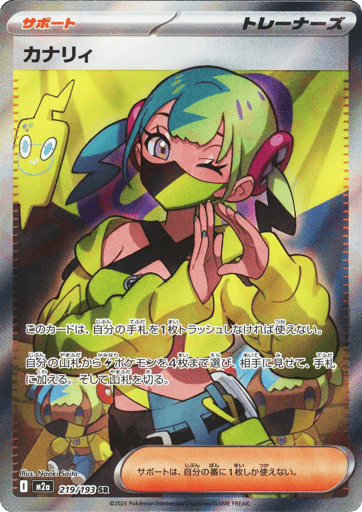
M2a 219/193・2025 カナリィ SR
Canary — no official English name announced
M2a 219/193 · Super Rare (SR)
Trainer — Supporter
High class pack “MEGA Dream ex”
Illus. Naoki Saito
30-day median (ungraded)
¥1,200
4-week trend (ungraded VWAP; sale count beneath)
Find this card on Collect2Day ›What this card demonstrates
The widest median-to-weighted-average gap of the three. The ungraded median is ¥1,200, but the weighted average across the same week’s sales is ¥1,533 — ¥333 higher. The table explains the gap: six sales this week, and just one the week before. At that thickness a single high sale is enough to lift a weighted average. The +15.3% week-on-week move is real; how much it is worth depends entirely on how few sales produced it. Worth noting too: this is the only Supporter trainer card of the three, so part of its demand comes from people who intend to play it rather than shelve it. If you are setting a number to buy at, ¥1,200 is the steadier one.
-
#2
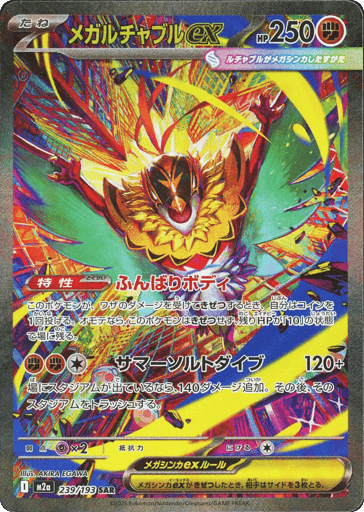
M2a 239/193・2025 メガルチャブルex SAR
The Mega Evolution of Hawlucha ex
M2a 239/193 · Special Art Rare (SAR)
Pokémon ex (Mega Evolution) — Fighting, HP 250
High class pack “MEGA Dream ex”
Illus. AKIRA EGAWA
30-day median (ungraded)
¥1,300
4-week trend (ungraded VWAP; sale count beneath)
Find this card on Collect2Day ›What this card demonstrates
This is the card the article is about. SAR is the top special-art tier in the set and the face is a Mega Evolution Fighting-type ex, yet its ungraded median of ¥1,300 is only ¥100 above the SR above it. The likely explanation is supply and demand in combination: a high class pack is opened in bulk, so SARs reach the market quickly, and Hawlucha is not one of this set’s headline characters. There is no print-run or pack-opening data here to test that, so it stays a hypothesis. What can be checked is the data quality: a ¥1,300 median against a ¥1,371 weighted average is a ¥71 gap — the tightest of the three, meaning the seven sales broadly agree on what the card is worth.
-
#3
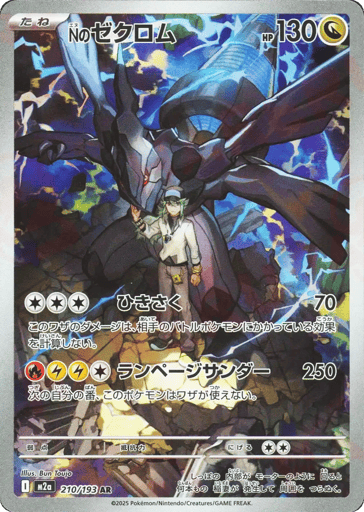
M2a 210/193・2025 Nのゼクロム AR
N’s Zekrom
M2a 210/193 · Art Rare (AR)
Pokémon — Lightning, HP 130
High class pack “MEGA Dream ex”
Illus. Bun Toujo
30-day median (ungraded)
¥1,000
4-week trend (ungraded VWAP; sale count beneath)
Find this card on Collect2Day ›What this card demonstrates
The floor of the three at ¥1,000. AR sits below SR and SAR in rarity, so the entry price is lower — and what it really sells is the illustration: the whole card is one scene, with the trainer N standing before Zekrom, which is what this tier’s buyers come for. The weighted average of ¥1,129 is about 13% above the median, which says some of the seven sales cleared above the floor. Note that its table has three columns, not four: the “1 week ago” period has no sales on record this period, so no change against the immediately preceding week can be computed. This article therefore makes no call on its short-term direction — absent data and an unchanged price are not the same finding.
Three questions to ask before buying at this price
FAQ
What does “ungraded” mean?
The card itself, never sent to a third-party grader to be assessed and sealed — also called Raw. The ungraded price and the PSA 10 price of the same card are two separate markets and do not convert into one another. For what separates the grades, see PSA 9 vs PSA 10.
Why is the SAR only ¥100 above the SR?
Supply and character demand are the two likeliest reasons: a high class pack is opened in bulk, so even a top tier reaches the market quickly, and demand for a non-headline character is narrower to begin with. For why rarity and price come apart, see SAR vs UR vs CSR explained.
Do trainer cards and Pokémon cards price the same way?
No. Part of a Supporter’s demand comes from actual tournament play, so format and metagame changes feed straight into it, while a high-rarity Pokémon card leans on character appeal and artwork. Card one here is a Supporter and cards two and three are Pokémon — landing in the same price band from two different directions.
Is a ¥1,000 card worth collecting?
Not investment advice. What the data can answer is a different question: how many sales produced that price, and how far the median sits from the weighted average. All three cards here trade on seven sales or fewer a week, which makes them reasonable to start with and unreliable to draw market conclusions from.
How long will these prices hold?
This article makes no forecast. Worth knowing: the set is still in its heavy pack-opening phase, with supply flowing in, which is when price structure moves most. The method — sale count first, then the distance between median and weighted average — outlives the figures.
Find these three cards on Collect2Day
Collect2Day buys direct from the Japanese market, so you pay Japanese prices and ship everything home in one consolidated parcel.
Start searchingPrices here are reference figures from ungraded Japanese market sales and are for comparison only. Live pricing moves; the figure on the Collect2Day page is the one that applies. Card type, attribute, HP and illustrator are read from the card face.